
The best CRM for small business is the one someone actually runs.
Most small-business CRMs fail from non-use, not missing features. A picking framework built on who will actually run the thing — plus a short, honest shortlist by situation.
John "Holliday" Mahlow
Founder, Cursive Media
Every "best CRM for small business" article ranks fifteen tools by feature count, and none of them mention the thing that actually decides the outcome: most small-business CRMs die of neglect. Bought after a good demo, contacts imported, and eight weeks later the real pipeline is back in someone’s text messages. The features never got the chance to matter.
So this is not a fifteen-tool review. Honestly, we couldn’t write one — we implement and run GoHighLevel for clients every week, and beyond a couple of platforms we know from real use, everything else would be us paraphrasing other people’s reviews. What we can give you is the thing the listicles can’t: the picking framework that predicts whether any CRM survives contact with your business, and a short list of where to start looking, labeled honestly — what we run versus what we know by reputation.
The only question that predicts success
Who is going to run this? Not "use" — run. Every CRM needs one person who keeps the pipeline honest, and the right tool depends entirely on who that person is.
If it’s the owner of a service business, between jobs, on a phone: the CRM must feed itself. Every form fill, call, text, and booking has to land in it automatically, because nobody is typing notes into a laptop from a crawlspace. If it’s an office team with someone who owns sales: you can afford a tool that expects daily human attention, and pipeline clarity beats automation breadth. And if the honest answer is "nobody": stop shopping. A CRM without an operator is a subscription to a guilt folder — fix the ownership question first, or stay on the shared inbox until you can.
The shortlist, by situation
Labeled the way we’d tell you across a table. One of these we deploy constantly; the others are the credible names for situations that aren’t ours, and we say so.
| Your situation | Start with | Why (and how we know) |
|---|---|---|
| Local service business — calls, bookings, reviews ARE the business | GoHighLevel | The one we implement weekly. CRM + phone/SMS + calendar + review asks in one $97–297/mo subscription, so the CRM feeds itself. Affiliate link below, disclosed. |
| Office / B2B team, someone owns sales | HubSpot | By reputation and client reports, not our daily use: the free-forever CRM is the standard starting point; paid seats from about $15–20/mo. Watch the tier jumps. |
| Sales-driven team that lives in the pipeline | Pipedrive | Research-labeled: the recurring recommendation for pure pipeline discipline without suite bloat. |
| Trades / field service at scale | Jobber or a field-service platform | Research-labeled: scheduling, quoting, and dispatch matter more than CRM purity — vertical tools fit better than generic ones. |
| Two people and a dozen customers | Nothing yet | Our actual advice: a shared inbox and a calendar are a fine CRM at this size. Buy software when the leads outgrow them. |
Why GHL is our default — and who it’s wrong for
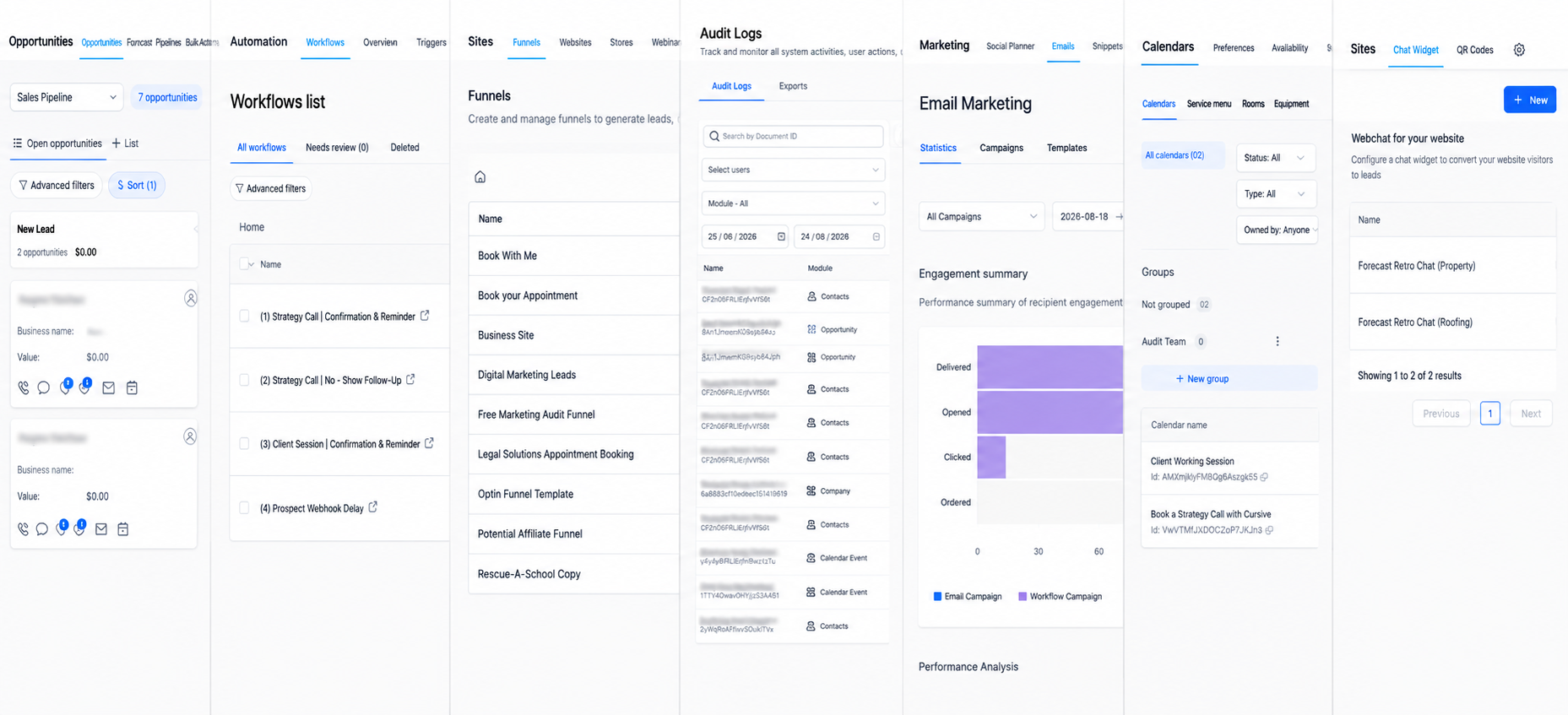
For the local service businesses we serve, GoHighLevel keeps winning for one structural reason: the operator problem from earlier disappears when the phone system, the booking calendar, and the CRM are the same product. A missed call texts back, the reply threads into the contact record, the booking fires the reminders — no one "updates the CRM" because the CRM updated itself. That’s the non-use antidote, and it’s why the pricing usually beats the stitched-together stack it replaces.
And the honest other half: it’s the wrong tool for plenty of businesses. E-commerce and product companies belong elsewhere; teams already happy in HubSpot or Pipedrive shouldn’t migrate for marginal gains; and GHL has real rough edges we’ve documented in is GoHighLevel legit and the alternatives worth considering. A badly configured platform loses to a well-run spreadsheet every time, whatever the logo says.
Whatever you pick, rig it against non-use
Three moves, doable in week one on any of the tools above. Automate the intake so every lead source lands in the CRM without a human copying anything. Run exactly one pipeline with five or six stages — the twelve-stage masterpiece is where deals go to hide. And wire the follow-up to fire from stage changes, so the system nags itself instead of relying on the owner’s memory. That wiring sequence is the spine of our 30-day automation roadmap.
Disclosure: links to GoHighLevel in this article are affiliate links, so we earn a commission if you sign up through them. It costs you nothing extra, and it didn’t write the "who it’s wrong for" section.
If the answer turns out to be GoHighLevel, running it properly is what we do — the platform is the smaller half, and the system built on top of it is the rest. If you’re staring at a dead CRM right now — or about to buy your second one — book a strategy call. We’ll tell you whether the problem is the tool or the operator question, and only one of those is fixed by shopping.
John "Holliday" Mahlow
Founder, Cursive Media