GoHighLevel pricing: what it replaces, what it costs, and where it falls short.
What GoHighLevel costs against the CRM, scheduling, email, funnel, and review software it replaces, plus the disadvantages nobody selling it mentions.
Founder, Cursive Media
- Read time
- 7 min read
- Updated
Nobody decides to spend $600 a month on marketing software. It happens one reasonable decision at a time. A CRM to keep track of leads. A scheduling link because the email back-and-forth got old. An email platform for the newsletter. A funnel builder for the spring promotion. A review tool because a competitor was drowning you on Google. A Zapier plan to make them all talk.
Each choice made sense. The total rarely does. If you’ve never added yours up, this post is the nudge, and a framework for deciding whether consolidating onto a platform like GoHighLevel is worth the disruption.
The stack most businesses are actually running
Prices move around, so treat these as the rough shape rather than a quote. A typical small-business stack looks something like this:
| Job | Typical tool | Rough monthly cost |
|---|---|---|
| CRM & pipeline | HubSpot, Pipedrive | $25–100+ per seat |
| Scheduling | Calendly | $10–20 per seat |
| Email marketing | Mailchimp, ActiveCampaign | $30–150 |
| Funnels / landing pages | ClickFunnels, Leadpages | $50–150 |
| Review management | Birdeye, Podium | $100–400 |
| Forms & surveys | Typeform, Jotform | $25–60 |
| Glue between them | Zapier | $20–100+ |
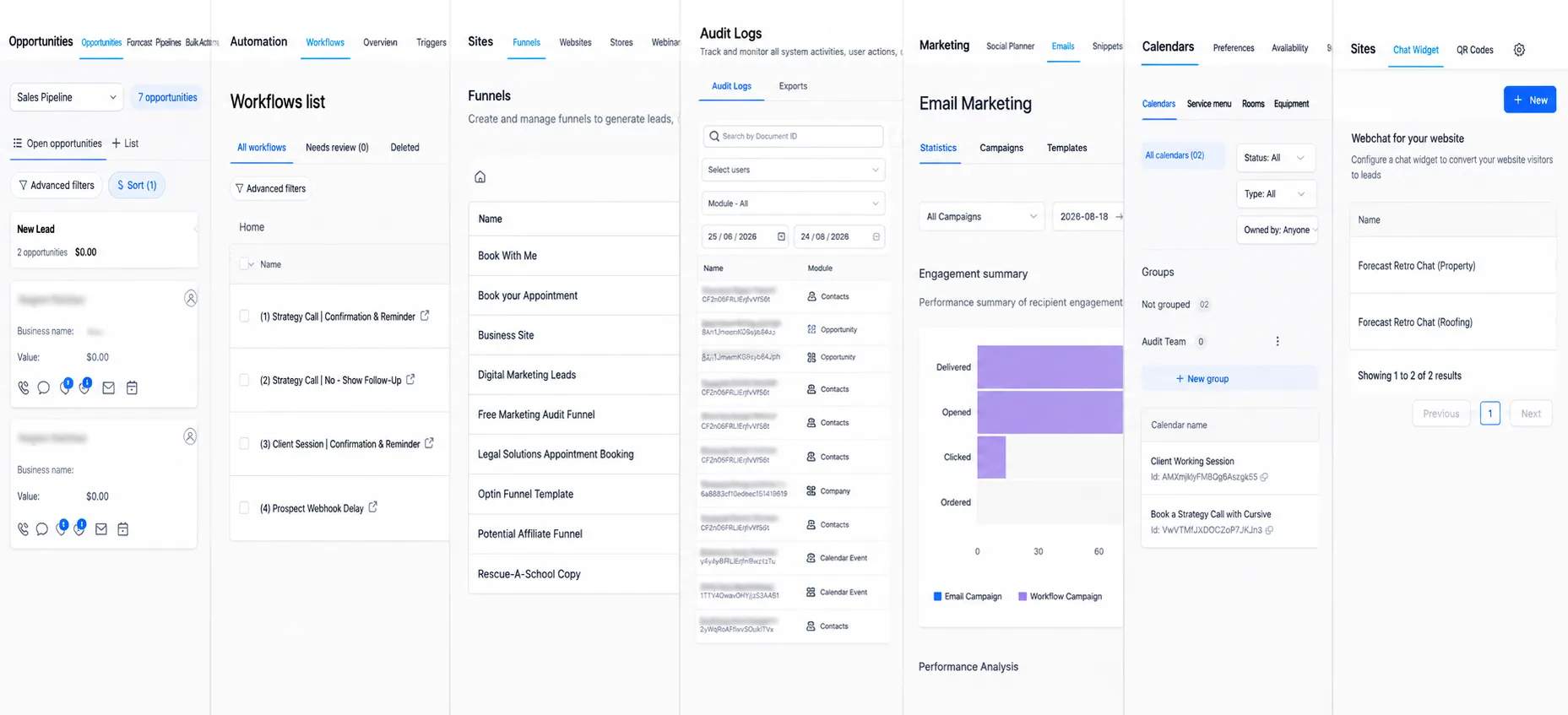
For a two-or-three-seat business, that lands between $300 and $800 a month, and it climbs as you add people and contacts, and again as volume grows. GoHighLevel bundles versions of all of those jobs into one subscription: $97 a month for the starter plan, or $297 for the unlimited tier, at the time of writing. Check the current page before you budget; the tiers move.
The costs that never show up on an invoice
The subscription math alone usually favors consolidation, but it undersells the real difference, because the stitched-together stack has costs that never appear on a bill.
- Sync failures. Every integration is a place where a lead can silently fail to arrive. Nobody notices until someone asks why a customer never got a reply. This is the Zapier tax in its most expensive form.
- The fragmented customer. The CRM knows one thing, the email tool another, the review platform a third, the scheduler a fourth. No single screen shows what actually happened with a given customer.
- Duplicate data entry. Someone re-types things between systems. That person is your most expensive integration.
- Onboarding drag. Every new hire learns five tools and five logins, plus the folklore about which one is the source of truth.
The disadvantages of GoHighLevel: what you give up when you consolidate
The trade isn’t free, and pretending otherwise is how bad migrations happen. Every module in an all-in-one platform is a little less polished than the specialist tool it replaces. If your email program depends on advanced deliverability tooling, or your business runs on a product catalog, the specialist may still deserve its line item.
There’s also migration cost: exporting contacts, rebuilding automations, rewriting messages, retraining the team, and running both systems in parallel for a few weeks. Budget real hours for that. A consolidation that saves $400 a month but is abandoned half-migrated costs more than the stack ever did. The sequencing in the 30-day roadmap applies almost verbatim to a platform migration.
You’re not buying software. You’re buying one version of the truth about every customer.
How to run the math for your business
- Add up every marketing and sales subscription, per-seat fee, and usage overage. That’s the visible number.
- Estimate hours per week spent re-typing and reconciling between tools (plus debugging the glue when it breaks). Multiply by a real hourly cost. That’s the invisible number.
- Count the leaks: leads that arrived somewhere nobody watches, follow-up that depends on memory. Price one lost job per month against them.
- Compare the total against the platform subscription plus a realistic one-time setup investment.
For most local service businesses the comparison isn’t close, but run it anyway, because the number that convinces your bookkeeper is the one with your own figures in it. And if the math points the other way, keep your stack; a working system you understand beats an elegant one you resent. That’s the same logic we apply to custom software in build vs. buy.
The part nobody budgets for
Whichever way you go, the platform is the smaller half of the project. The larger half is the system built on top of it: the mapped customer journey, the workflows, the messages, the edge cases, the failure alerts. Our GoHighLevel service exists because that half is where consolidations succeed or quietly die.
If you want a second set of eyes on your stack (what to consolidate and what to keep, plus what the migration actually involves), book a 20-minute strategy call. Bring your subscription list.
Disclosure: links to GoHighLevel in this article are affiliate links, so we earn a commission if you sign up through them. It costs you nothing extra, and it didn’t soften the disadvantages section above.
Founder, Cursive Media