What is GoHighLevel, and does your business actually need it?
A plain-English breakdown of what GoHighLevel does, what it replaces, roughly what it costs, and how to tell whether it fits your business.
Founder, Cursive Media
- Read time
- 8 min read
- Updated
If you own a local business, someone has probably already pitched you GoHighLevel. An agency wanted to put you on it, or a YouTube video promised it would replace your entire marketing department. Maybe a competitor just mentioned it at a trade event. Either way, the name keeps showing up.
Most of those pitches skip the part you actually need: what the platform is, what it genuinely does well, where it falls short, and how to tell whether your business is the kind that benefits. This is that explanation, without the affiliate link.
What GoHighLevel actually is
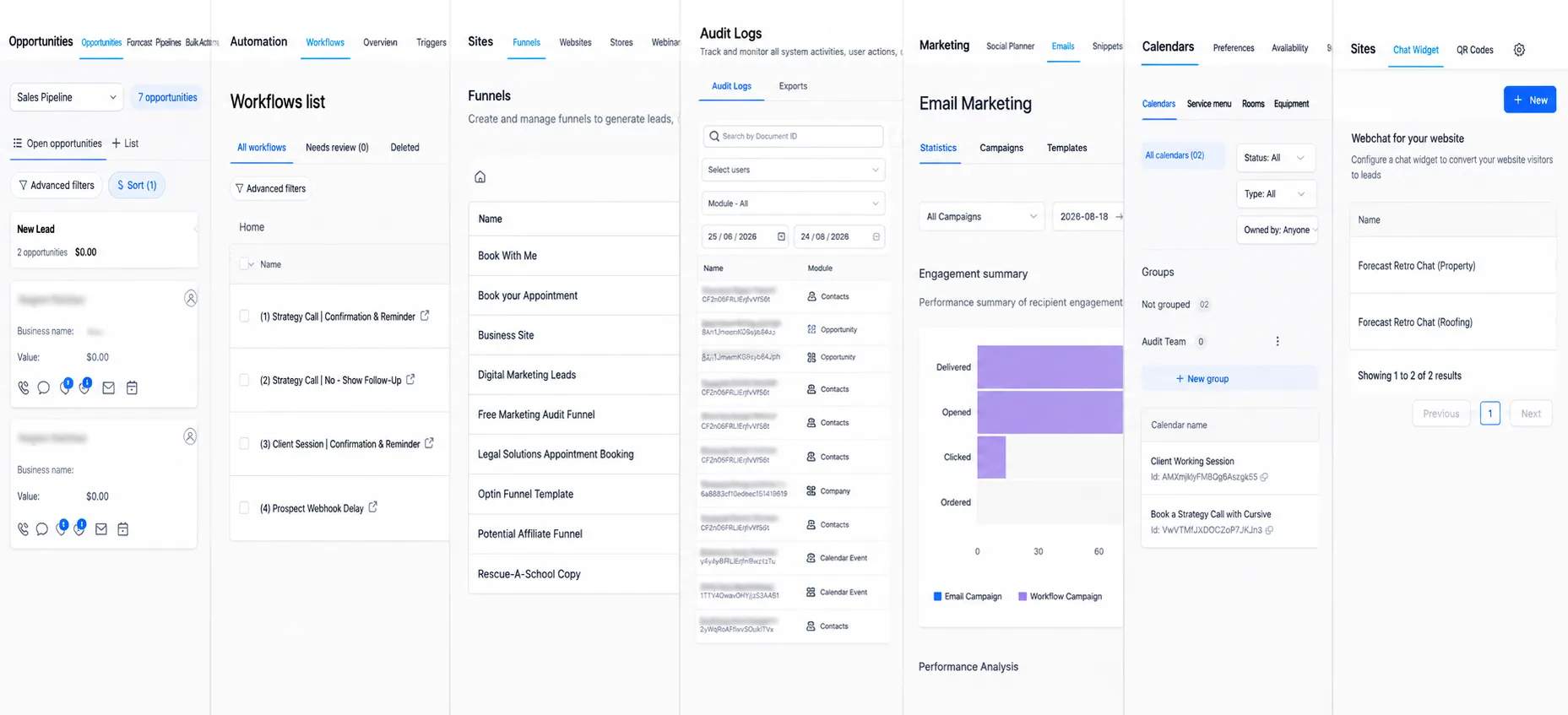
GoHighLevel (usually shortened to HighLevel or GHL) is an all-in-one sales and marketing platform. Instead of doing one job extremely well, it does most of the jobs a local business needs in one place: a CRM with pipelines, two-way text and email conversations, phone calls and call tracking, appointment calendars, website and funnel building, review management, and a workflow builder that automates the connections between all of it.
It was originally built for marketing agencies, which explains two things about it. First, it’s white-label friendly: many businesses use GHL every day under a different name their agency put on it. Second, it’s designed around the handful of problems nearly every local business shares: leads that go cold, calls that get missed, appointments that get forgotten, and reviews that never get asked for.
The consolidation argument
The core pitch is consolidation. A typical growing business runs a CRM, an email tool, a scheduling tool, a funnel builder, a review platform, and a pile of Zapier connections holding it together. Each tool has its own login and its own bill. Each keeps its own copy of the customer.
GHL replaces most of that stack with one system and one contact record. When the same platform answers the missed call, books the appointment, sends the reminder, and requests the review, you get something the stitched-together stack can never quite deliver: a single timeline of every interaction with every customer. We break down the actual money side of this in what GoHighLevel costs against the stack it replaces, but the short version is that most businesses replace $300–800 per month of software with a subscription that starts at $97 per month at the time of writing.
What it is genuinely good at
- Speed to lead. Forms, calls, chats, and ad leads all land in one place and can trigger an instant, honest response, which is the single highest-ROI automation most local businesses can ship. It anchors the list in 10 things every local business should be automating.
- Missed-call text-back. A missed call fires an automatic "Sorry we missed you. How can we help?" text before the caller reaches the next name on Google.
- Appointment workflows. Booking calendars, confirmations, reminders, reschedule links, and no-show follow-up, all native rather than glued on.
- Review generation. Completed jobs trigger review requests, and replies land back in the same conversation view.
- Pipelines that trigger things. Moving a deal to "estimate sent" can start the follow-up sequence; "won" can start onboarding and invoicing.
Where it falls short
Honesty matters here, because the internet is full of people selling GHL rather than describing it.
It’s a jack of all trades. Every module is good; almost none is best-in-class. A dedicated email platform has stronger deliverability tooling. A dedicated e-commerce platform handles catalogs and tax far better. If one specific channel is 90% of your revenue, a specialist tool for that channel may still earn its keep.
The learning curve is real. GHL exposes an enormous amount of surface area, and the interface assumes you already know what a workflow is, what a trigger does, and where a pipeline stage fits. Most owners who churn off the platform never got past a half-configured account. If yours is half-configured right now, audit it in this order before you cancel.
And the big one: a blank GHL account does nothing. The subscription buys you capability, not a system. Someone still has to map your customer journey, write the messages, build the workflows, wire the calendars, and test the edge cases. That work is the difference between "we pay for GoHighLevel" and "our follow-up runs itself," and it’s the same discipline we walk through in the 30-day automation roadmap.
GoHighLevel is not a marketing department in a box. It is the box a good marketing system gets built in.
Is GoHighLevel legit, and who is behind it?
It’s a real company with a real product, not a rebranded template. HighLevel launched in 2018 and is headquartered in Dallas, Texas. Today it runs the marketing operations of a very large number of agencies and the businesses they serve. The reason the question gets asked so often is the marketing around it: because the platform pays agencies to resell it, the internet is thick with affiliate content promising it will replace your marketing department. The hype deserves your suspicion; the software underneath it holds up. If you want the long version, we’ve answered the legit question in full: company history, third-party ratings, and what actually goes wrong.
The white-label model is also why you may already be using it without knowing. If your agency logged you into a CRM at a domain with their name on it, there’s a decent chance you were looking at GHL.
What kinds of companies use GoHighLevel?
Two groups. Marketing agencies use it to run many client accounts from one login; that’s the audience it was designed for. And local service businesses use it directly: home services, contractors, medspas, clinics, gyms, real estate teams, law firms, and anyone else whose revenue depends on catching a lead fast, booking an appointment, and getting a review afterwards.
The common thread isn’t industry so much as shape: high inbound lead volume and appointments as the conversion event, with reputation as the deciding factor. If your business doesn’t have those three, the platform has less to offer you regardless of the price.
So, does your business need it?
It’s probably a strong fit if most of these are true: you’re a local or service business that lives on leads and appointments (and the reviews that follow); you juggle four or more tools that don’t talk to each other; leads slip through the cracks when things get busy; and nobody follows up on estimates in any consistent way.
It’s probably the wrong move if you’re a single-channel business with one simple funnel that already works, or if you’re deeply invested in an enterprise CRM with years of process built around it. It’s also the wrong move if nobody in the company will own the system after it launches. Consolidating tools you weren’t really using doesn’t create value; it just relocates the shelf they sit on.
The honest way to adopt it
Don’t start with the software. Start with the leaks: where do leads, appointments, payments, and reviews currently fall through? (Our lead-generation audit walkthrough is the systematic version of that question.) Then implement GHL against that list. Three dependable workflows first, everything else later.
That configuration work is what we do at Cursive Media: we build and run GoHighLevel for businesses that want the outcome without becoming platform experts. Book a 20-minute strategy call if you’d like a second opinion before committing; we’ll map your customer journey against what the platform can actually automate. And if GHL turns out to be the wrong tool for your situation, that’s exactly what we’ll tell you.
Disclosure: links to GoHighLevel in this article are affiliate links, so we earn a commission if you sign up through them. It costs you nothing extra, and it doesn’t change a word of what we said above, including the parts about where the platform falls short.
Founder, Cursive Media