
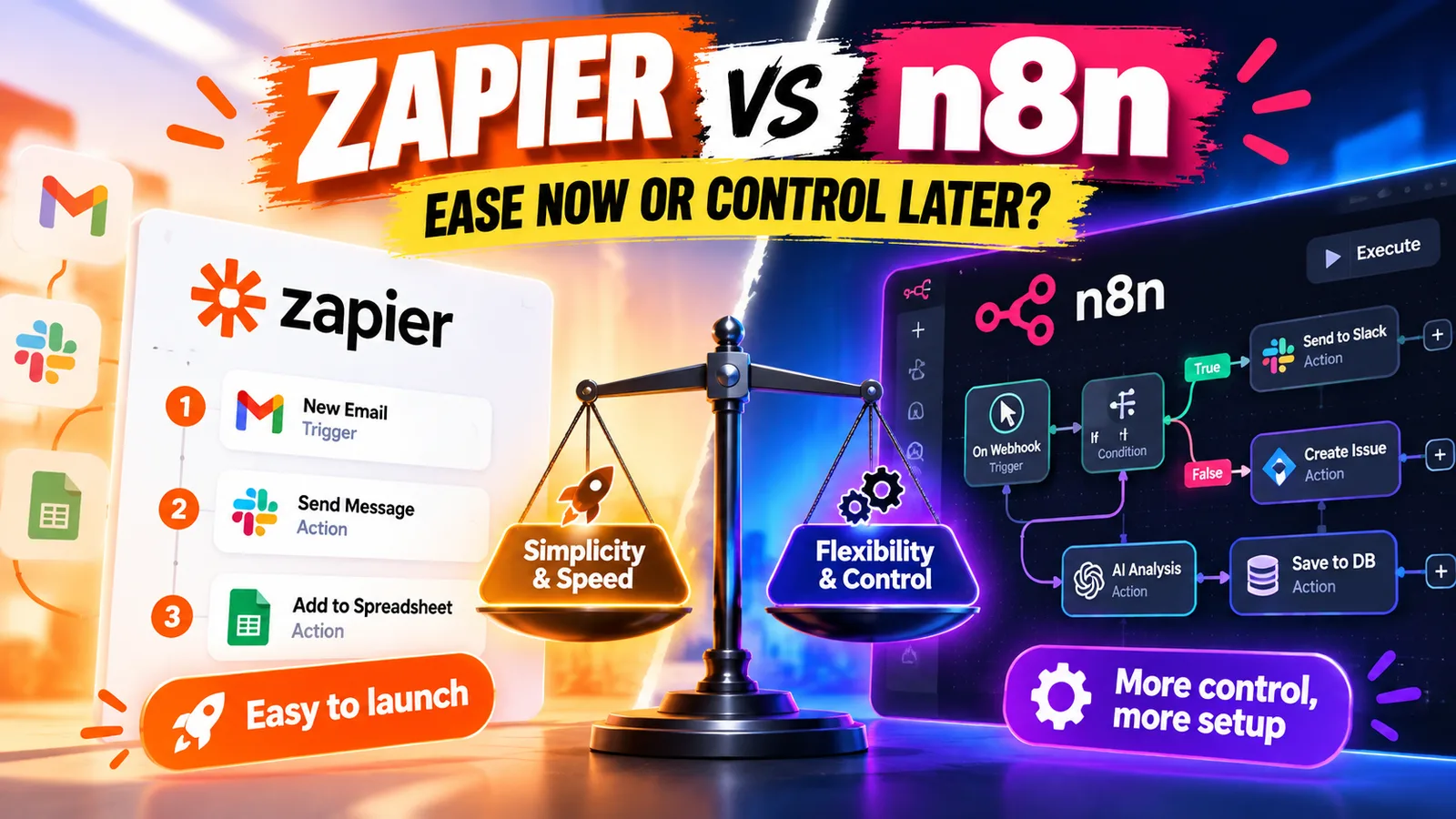
Zapier vs n8n: what “free and self-hosted” actually costs.
Zapier vs n8n on the numbers that matter: task meters against executions, the real price of self-hosting, and who should actually run n8n.
Founder, Cursive Media
- Read time
- 8 min read
- Updated
TL;DR
- Zapier bills a task for each successful action step; n8n bills one execution per workflow run, however many steps it has.
- Self-hosted n8n has no software bill, but you carry the server, updates, backups and the Saturday fixes.
- Agencies can run client workflows on their own free n8n instance if clients never touch the editor; letting clients build workflows needs a commercial license.
If you’ve heard of n8n at all, it was probably from a YouTube thumbnail with an arrow pointing at an AI agent. The pitch writes itself: Zapier charges by the task while n8n is free and self-hosted, so switch. We build automations on both, and the pitch is half true in a way that costs people real weekends.
The comparison needs two answers, because the two products disagree about what you’re buying. Zapier sells a metered service. n8n hands you software and wishes you luck with the server.
The meters aren’t the same shape
Zapier counts tasks: each action step that succeeds uses one, while the trigger, filters and formatter steps are free (we’ve broken down where that meter leads). n8n counts executions: per its pricing page, one run of a workflow is one execution "regardless of complexity." Take a workflow with a trigger and eight action steps that runs 500 times a month.
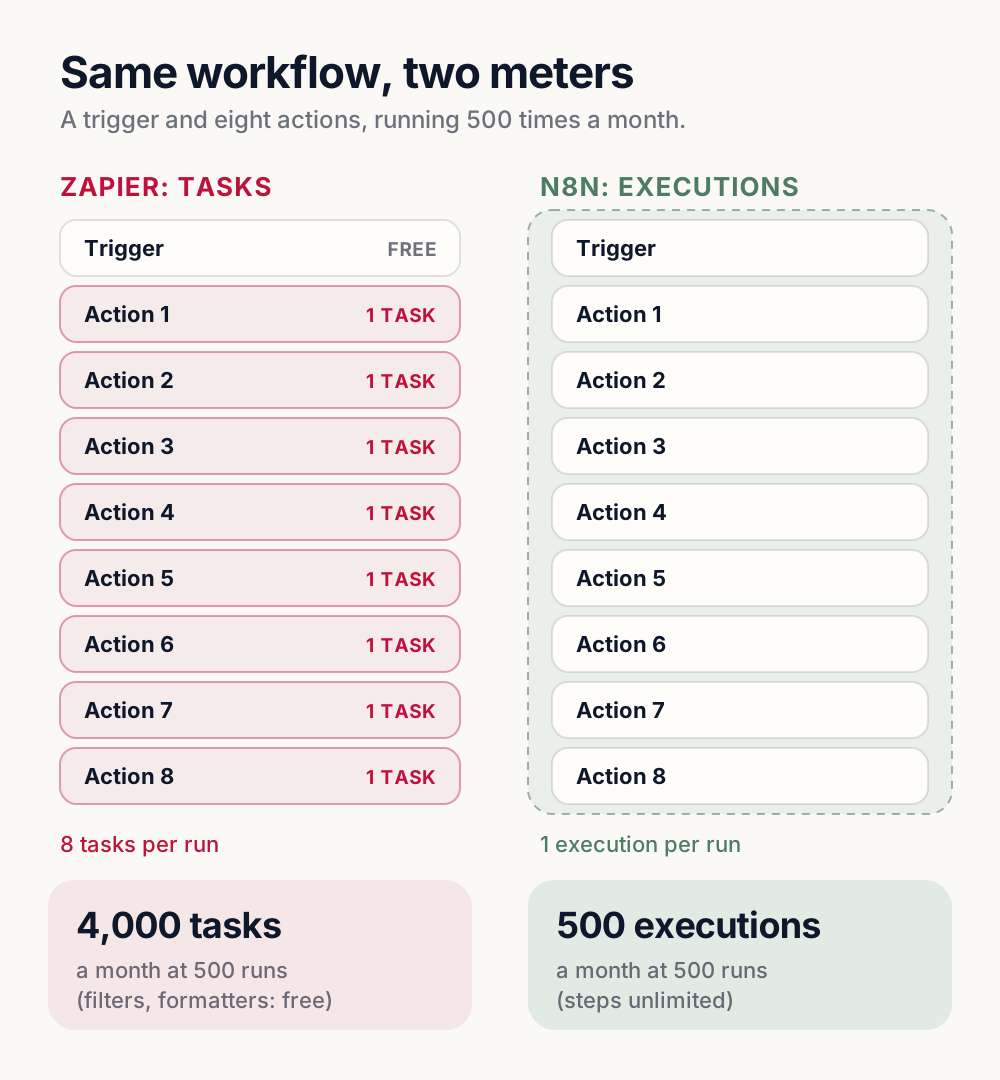
On Zapier that’s 4,000 tasks, which needs the 5,000-task tier at $89 a month billed annually. On n8n it’s 500 executions, well inside the cloud Starter plan’s 2,500, at €20 a month billed annually with steps explicitly unlimited. Pro is €50 for 10,000. Prices as listed on October 11, 2026.
Step-heavy workflows are exactly where AI automation lives. An agent that reads an email, checks a calendar, drafts a reply, and logs the thread is one execution on n8n and a fistful of tasks on a task meter. That, more than ideology, is why the AI crowd standardized on n8n.
What “free and self-hosted” buys you
The community edition is genuinely free: download it, run it on your own server, no execution meter at all. The license (n8n calls it the Sustainable Use License) covers automating your own company squarely, at zero software cost, forever. Agencies have more to read, covered below.
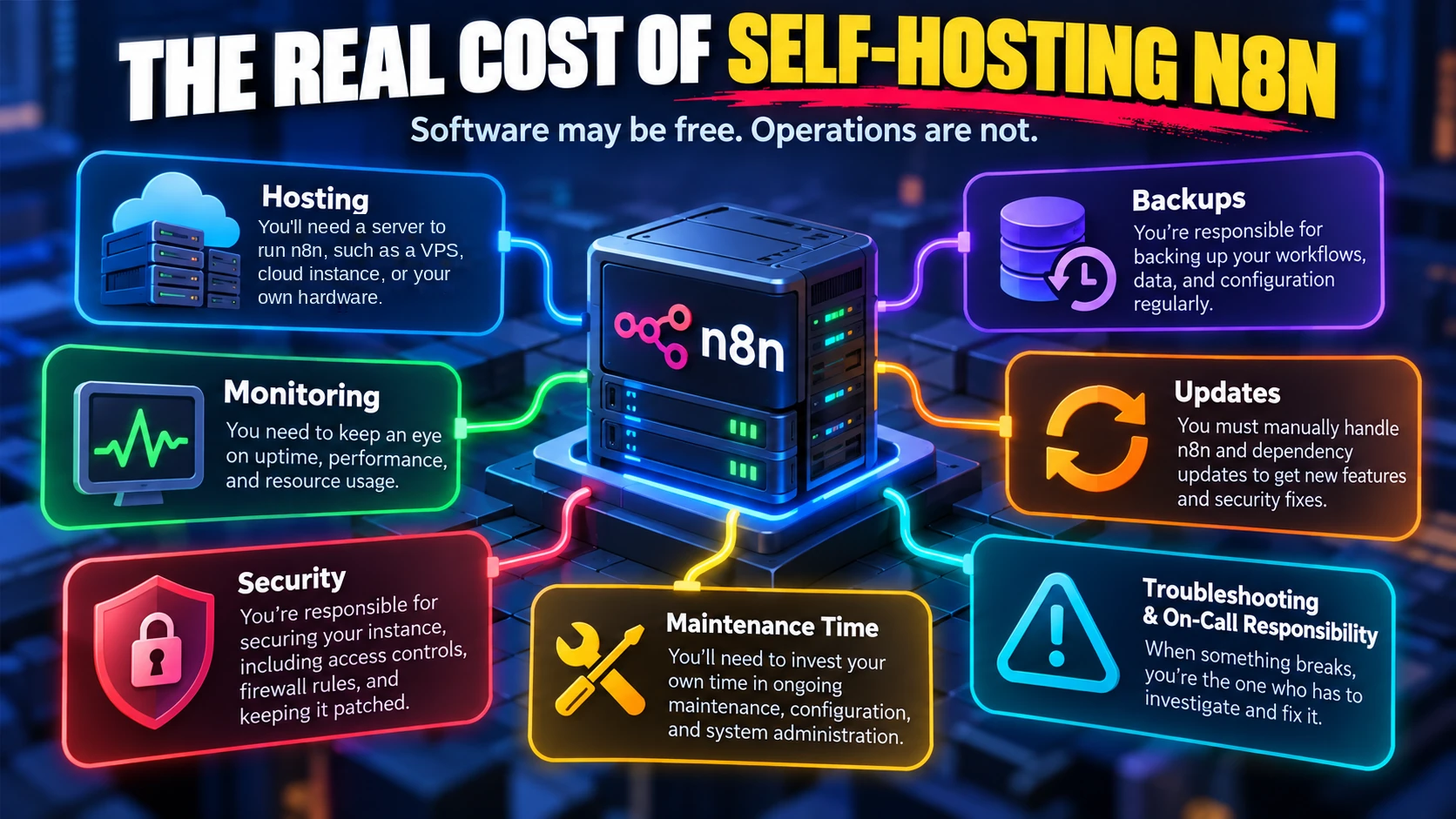
The software costs nothing. The system is another story. Here’s who carries each cost, with “Cloud” meaning Zapier or n8n Cloud:
| Cost | Who carries it |
|---|---|
| Software | Cloud: a metered plan. Self-hosted: free. |
| Server | Cloud: included. Self-hosted: a VPS you rent. |
| Patches | Cloud: the vendor. Self-hosted: you, on a schedule you test. |
| Backups | Cloud: the vendor. Self-hosted: you, including a tested restore. |
| Failures | Cloud: your workflow logic. Self-hosted: your logic and the box. |
| Outages | Cloud: the vendor’s problem. Self-hosted: yours, all weekend. |
The math that decides it is simple: self-hosting pays off when the cloud bill you’d stop paying is bigger than the hours of upkeep times what those hours are worth. Against a €20 Starter plan, that is not many hours.
A meter you don’t pay in dollars gets paid in attention.
We run our own servers, so this isn’t self-hosting scaremongering; it’s a staffing question. If nobody in your business enjoys being root on a Linux box, the free tier isn’t free. The €20 cloud tier is, functionally, the cheap option.
Where Zapier still earns the subscription
The honest case for Zapier hasn’t changed since our Make comparison: the biggest app catalog anywhere, and a form-style builder a non-technical owner can ship with in an afternoon. n8n’s canvas is closer to visual programming, expressions and real error handling included. Wonderful if you think in flows; a wall if you don’t. Zapier is for the office manager. n8n is for whoever already has Docker installed.
The decision, sorted by who you are
No technical owner: stay off n8n entirely
Cloud or self-hosted, somebody has to debug a failed node at some point, and if the answer to “who fixes it” is an agency you’d have to call anyway, buy the layer where failures are the vendor’s problem. Better yet, ask whether the workflow belongs on middleware at all or inside the platform that runs your business, where the core loops are native.
Technical owner, real volume: n8n cloud first, metal later
Start on the €20 cloud tier and prove the workflows matter. Move to self-hosting when execution volume, data-privacy requirements, or sheer tinkering joy makes owning the box worth it. The workflows come with you as JSON, but plan the move like a migration, not an export. Per n8n’s export docs, the file carries your credentials’ names and IDs, not the secrets, so every connection gets set up again on the new instance. And every webhook URL still points at the old host until you change it wherever it’s used. What you shouldn’t do is start with a bare VPS on day one to save €20 before you know the automation earns anything.
Agencies: mind the license
If you’re reading this as an agency planning to “offer n8n” to clients, the line is about who touches the workflows, not who pays you. n8n’s license FAQ draws it like this:
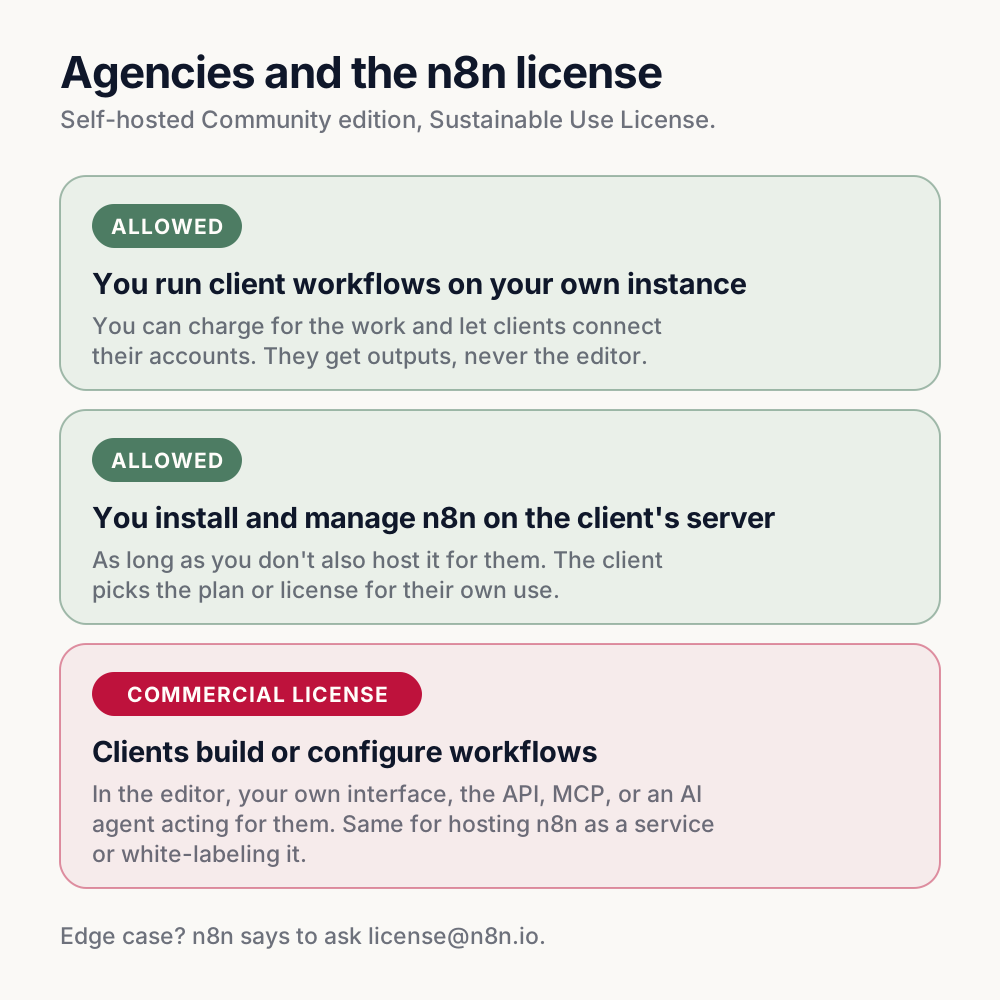
So the first two lanes are open on the free Community edition. The moment a client can build or change a workflow, through any interface, you need a commercial license. n8n says its help desk can’t confirm specific cases and points questions to license@n8n.io; get the answer in writing before you build a business on an edge case.
The bill in three currencies
Zapier charges dollars per task and hides the ops. n8n cloud charges euros per execution and hides most of them. Self-hosted n8n charges no money and bills you in ops: the patching, the backup you forgot, the 2 a.m. restart. There’s no free tier anywhere, just a choice of currency, and the right one depends on whether your business has more spare cash or spare engineering.
Sorting workflows across those layers is the actual job, and it’s the first thing we do in our automation practice, often cutting the metered volume before any tool switch happens, Zapier included.
Founder, Cursive Media