What is a GoHighLevel agency? One explains its own business model.
What a GoHighLevel agency actually is, how the white-label markup works, the account-ownership catch, and the questions to ask before you sign with one.
Founder, Cursive Media
- Read time
- 7 min read
- Updated
You searched this for one of two reasons. Either an agency pitched you and the phrase "we're a GoHighLevel agency" meant nothing, or you just discovered the CRM you've been paying for lives at some other company's domain and you're wondering what exactly you've been buying.
We run a GoHighLevel agency, so consider the source. But that also means we can explain the business model from the inside, including the parts the pitch usually skips.
The two kinds of GoHighLevel agency
Picture a roofer who logs in at app.abcmarketing.com and sees ABC Marketing's logo. Underneath, it's GoHighLevel, and the roofer's login is one sub-account, a single client's own space inside ABC's agency account. If ABC charges only for that login, it's selling software. If ABC also wrote the follow-up texts, built the booking calendar, and fixes them when they break, that part is the service.
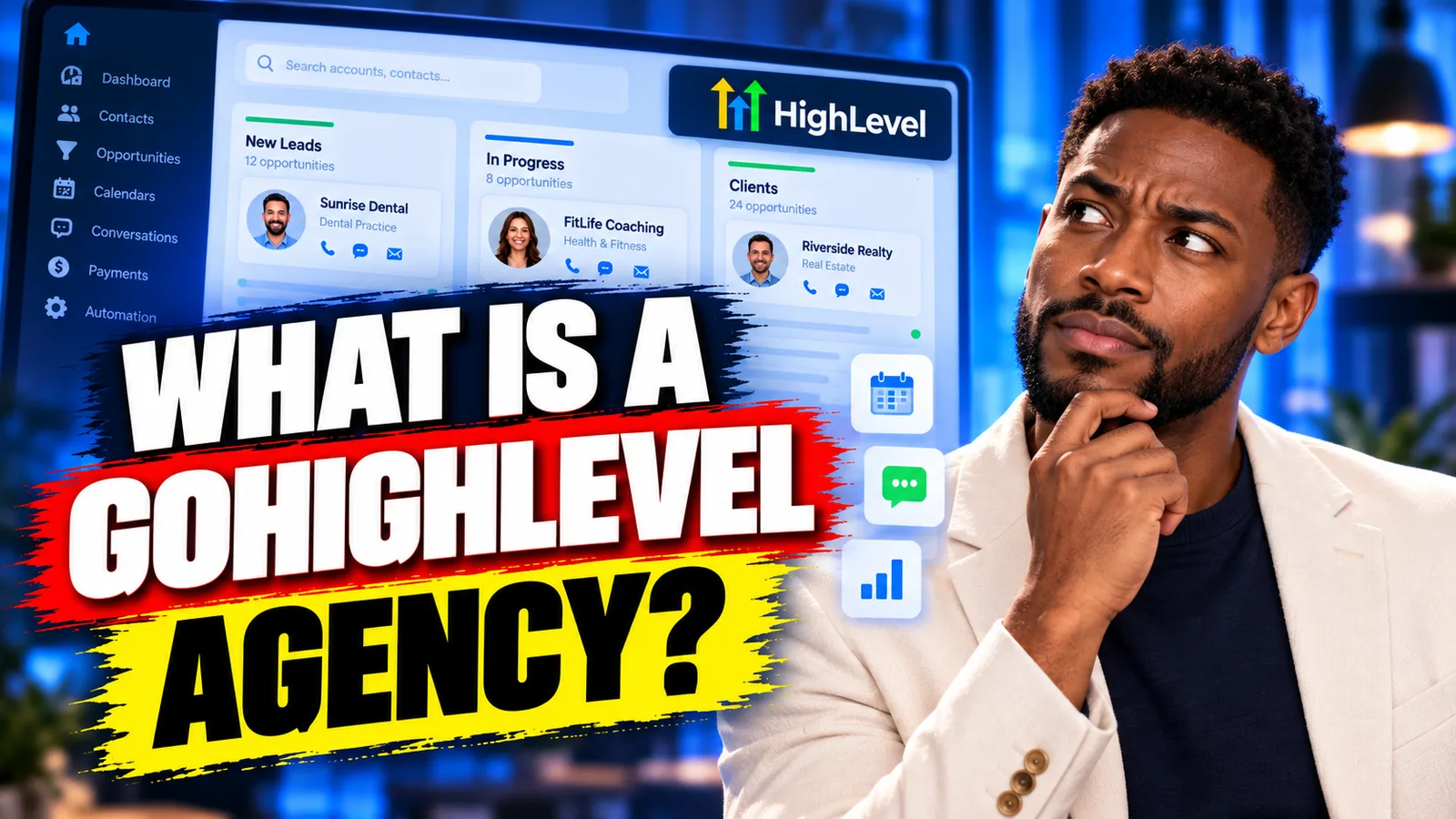
GoHighLevel is an all-in-one sales and marketing platform that was built for agencies first, and its pricing makes the agency model explicit. At the time of writing, the $297-a-month Unlimited plan gives an agency unlimited client sub-accounts under its own branding, and the $497 Agency Pro tier adds SaaS mode, which lets the agency resell the platform as if it were the agency's own software, at whatever price it likes.
That produces two very different businesses wearing the same label. An implementation agency sells the work: mapping your customer journey, building the workflows and calendars, wiring the review engine, and running the system after launch. A reseller sells access: your own login to a rebranded copy of the platform, sometimes with a setup template, at a monthly price that covers the software plus margin.
The rebrand isn't the product. The build is.
Margin itself isn't the scandal; every service business has one. The question that matters is what rides on top of it. If the answer is "a login and a logo," you're paying agency prices for software you could buy directly for $97 a month.
How to tell if you're already a GoHighLevel customer
A huge share of businesses using GHL every day have never heard the name. The tells: your CRM login lives at a domain like app.youragency.com, the interface has pipelines, Conversations, and a workflow builder, and the mobile app your agency told you to install is a rebranded LeadConnector.
This matters beyond trivia. HighLevel's support only talks to agency-level admins, so if your dashboard carries an agency's logo, your support line is your agency, not HighLevel. Good agencies make that a feature: someone who knows your build answers fast. Absent agencies make it a trap: you can't reach them, and you can't reach the platform behind them either.
What a good one actually charges you for
A blank GoHighLevel account does nothing. The subscription buys capability; somebody still has to turn capability into a system that answers the missed call and chases the estimate, books the appointment, then asks the finished job for a review. That build, and the ongoing tuning after it, is the legitimate product.
Concretely, the work looks like: your customer journey mapped against what the platform can automate, workflows built and tested against real edge cases, messages written in your voice rather than a template's, calendars and phone numbers wired and verified, failure alerts so broken automations surface loudly, and a named human who tunes the system as your business changes. If your monthly invoice can't be traced to items on that list, ask what it does trace to.
The red flags, from someone who competes with them
- The setup was a snapshot. Template accounts deployed in an afternoon are fine as starting points and dishonest as finished builds. If your "custom system" went live in a day, it's a stock template.
- Nothing is documented. You shouldn't need the agency on the phone to know what fires when a lead comes in.
- The account is hostage. If every workflow lives inside the agency's master account with no export path, leaving them can mean rebuilding the workflows from scratch. Ask before signing, not after.
- The price hides the software. You should know what part of your bill is platform and what part is service. Vagueness there is a choice.
- No one owns your account. If every question goes to a general inbox and gets a different person, the operation is resale, not service.
Five questions before you sign with any GHL agency
A real operator answers all five of these without flinching, because a real operator has been asked before. Hesitation on any of them is information.
1. Who owns the sub-account, and what exports if we part ways?
"You own it" covers three separate things, so ask about each. Access: HighLevel only lets admin users export contacts, so you want an admin login of your own, not a shared one. Data: an admin can export your contacts as a CSV, though the file leaves out automation history like past emails and texts. The build: workflows, funnels, and calendars don't come along in a contact export. HighLevel can transfer a whole sub-account to another agency, contacts and conversations included, but only an agency owner can request it. Whether yours will is what your exit terms decide, and the time to decide them is before the build, not during the breakup.
2. What exactly gets built in the first 30 days?
Listen for deliverables named against your business: your pipeline stages, your follow-up messages, your calendars. "We'll deploy our proven system" with nothing behind it is the template answer, in both senses.
3. Who answers when a workflow breaks, and how fast?
You're looking for a named human and a response time. A general inbox with no promise attached means you'll find the real answer on the Friday it breaks.
4. What does month three look like, once setup is done?
Good agencies can describe the ongoing work: monitoring, tuning, new workflows as your business changes. If the honest answer is "the subscription continues," you've found a reseller, and you now know what the margin buys.
5. What happens to my phone numbers, domains, and history if I leave?
Numbers and domains registered under your name port with you; ones registered under the agency's are theirs to release. Ask which yours will be. This single question prevents the ugliest version of the breakup.
When you don't need an agency at all
If you're technical enough to enjoy the workflow builder, your funnel is simple, and you have the evenings to spend, buy the platform directly and skip the middleman. What it costs against the stack it replaces covers that math. The agency earns its fee when the system is complex enough, or your time is expensive enough, that "done and monitored" beats "possible and pending."
That's the model, from inside it. Our version of the service is the implementation kind: we build and document the system, then run it. You own the results, and the platform bill is never disguised as magic. If you're holding a GHL agency pitch and want a second opinion on what it would actually get you, book a strategy call. Worst case, you'll walk away knowing exactly which questions to ask them.
Disclosure: the "buy directly" GoHighLevel link above is an affiliate link, so we earn a commission if you sign up through it. It costs you nothing extra. And yes, we see the irony of an agency post linking you around agencies. That's the point.
Founder, Cursive Media