Gemini can run your Google Business Profile now. Here’s how to set it up.
How to connect it, why the button may be missing, what the business notebook builds its picture from, and what to do with the search keywords it hands you.
John "Holliday" Mahlow
Founder, Cursive Media
- Read time
- 13 min read
- Written
Google’s video makes it look like one click. You sign in to Gemini, a banner invites you to create your business notebook, you press Connect, and Gemini starts telling you what your business needs.
We connected the Cursive Media profile this week. The banner never came.
What did work was typing @Google Business Profile into a prompt. Gemini asked permission to turn on the app, showed a dialog listing what it would read, and connected. The notebook showed up after that. So did three posts on our live profile, each one held behind a confirmation card until we said yes. And one thing did not happen at all, which we’ll get to.
Here is what this feature is, who can use it today, what the notebook actually knows about you, and which of its findings you can fix in five minutes versus which ones are pointing somewhere else.
What Google shipped, and what it won’t do without you.
Google announced the Business Profile connection and business notebooks on June 10, 2026, rolling out globally except the EEA and UK. The Help Center page is where the real detail lives. Once connected, Gemini can update your hours, contact info, attributes, action links, and menus. It can pull your reviews, draft replies, and create, schedule, publish, or delete Update, Offer, and Event posts. It can summarize what customers are saying. And it can show you your performance metrics and the search keywords people used to find you.
Read that list carefully, because the verbs matter. For reviews, Google says "draft or delete replies." It does not say post.
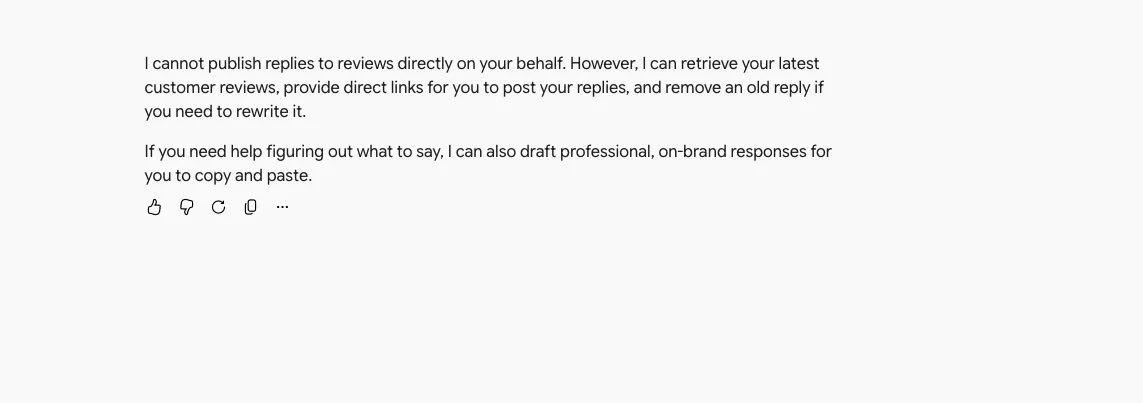
That is exactly what happened to us. We asked Gemini to reply to a review and it said it could not publish replies on our behalf. It would fetch the reviews, draft a response for us to paste, hand us the direct link, and delete an old reply if we wanted to rewrite one. We pushed back. It apologized, then said the same thing in different words: the one thing it can’t do is hit submit on a new reply.
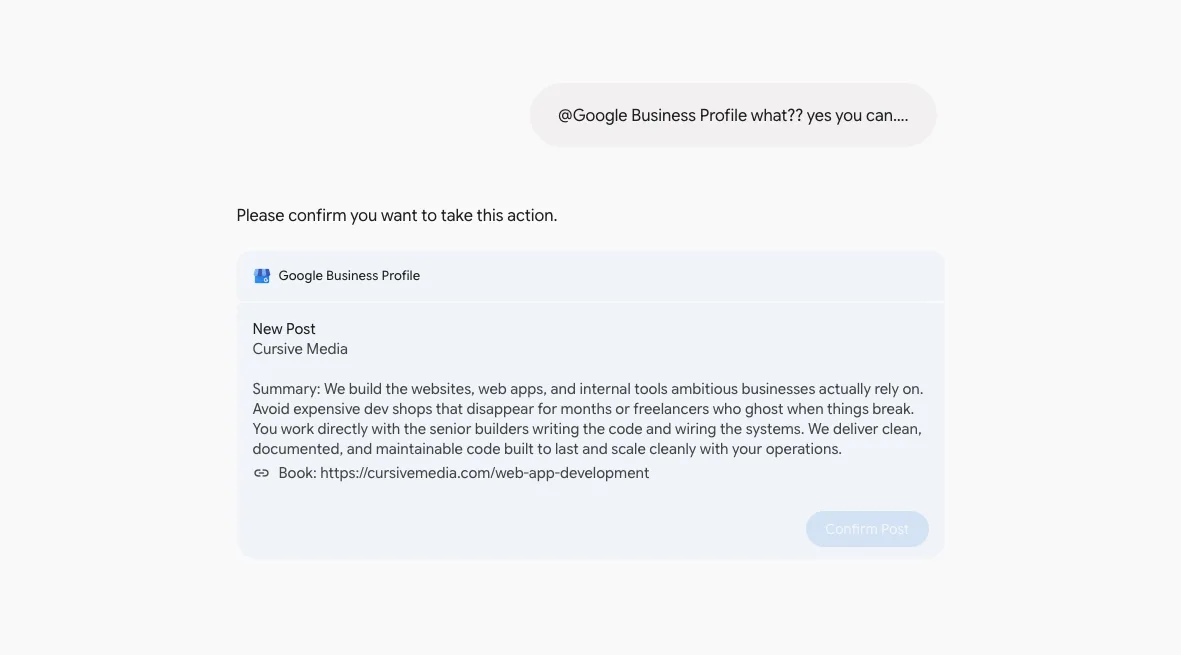
Posts are different. Gemini wrote three, showed each one in full with its link, and waited for "Confirm Post" before anything went live. Google’s small-business newsletter in August put it plainly, as PPC Land reported: Gemini generates drafts and suggested updates only, and nothing publishes without the owner’s review and sign-off. Edits go through the same official Business Profile API, with the same trust and verification checks, as anything you type into the dashboard yourself.
We tell every client the same thing about review replies: whether AI touches them at all is your decision, not ours. Google’s design here makes that decision for you in one direction. It will write the reply. You will post it.
How to set it up.
Five minutes, if your account qualifies. If it doesn’t, the next section says why.
- Go to gemini.google.com and sign in with the personal Google account that owns or manages the profile. Not your company email.
- Click into the prompt box and type @. A menu of apps opens: Calendar, Keep, Drive, Gmail, and further down, Google Business Profile. Keep typing "google bus" to filter the list, click it, and the tag drops into your prompt as a chip.
- Type anything after the chip, "what are my current hours" will do, and send it. If the app isn’t connected yet, Gemini answers with a permission card instead of an answer. Press Continue.
- A dialog titled "Connect Google Business Profile?" lists what Gemini will access and what it will share. Read it, then press Connect. The data section further down is about this screen.
- Gemini answers your question, and should now offer to create your business notebook. Press Connect there too, and enter or confirm your website URL when it asks. If that offer never shows, type the tag into a new prompt. Google’s own tip is that this makes Gemini offer to set the notebook up.
- Open the left sidebar. The notebook is under Notebooks, named after your business. Ours is "Cursive Media Insights."
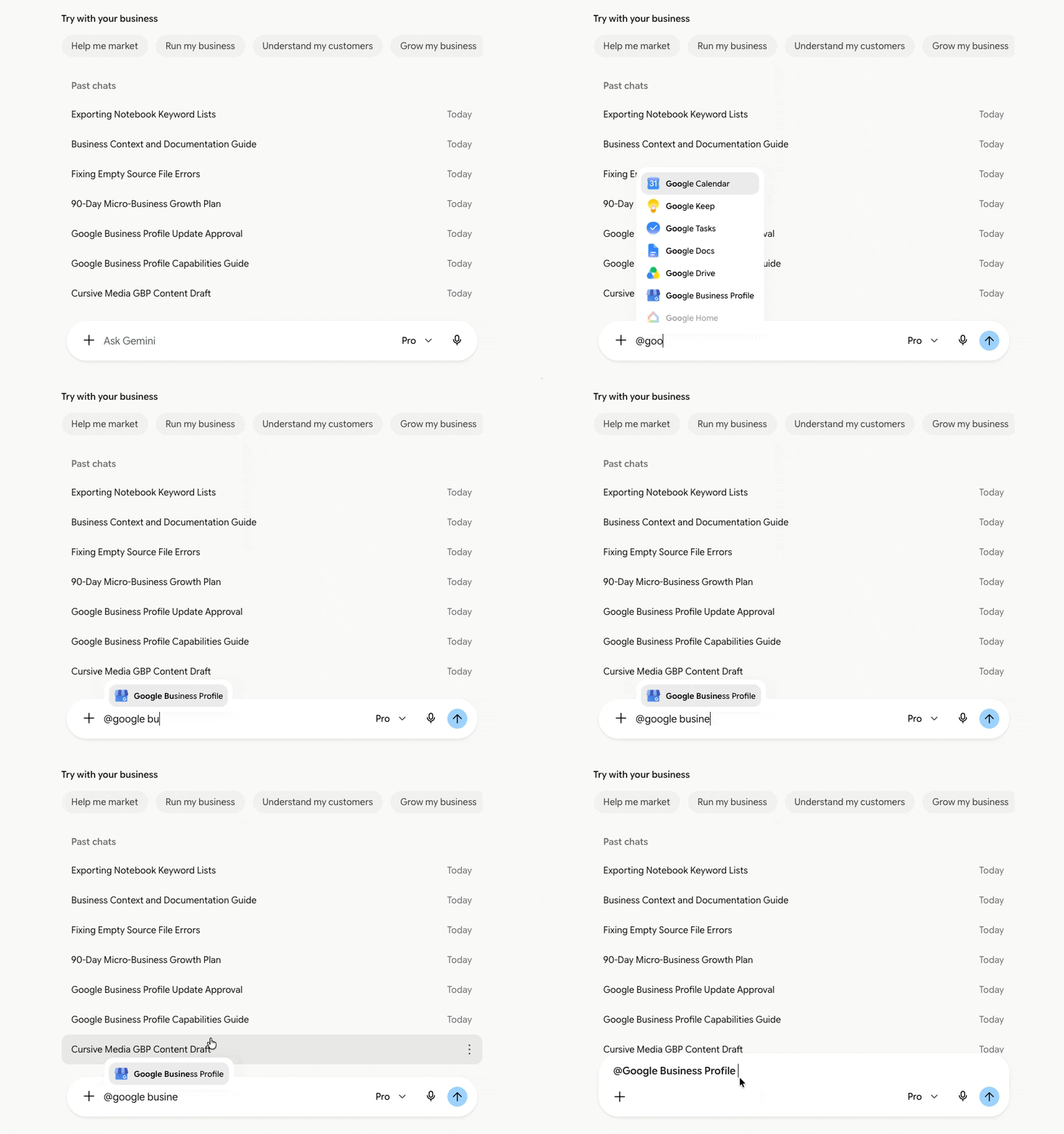
Steps 3 and 5 are where it fails for most people right now, and both fail quietly. No error, just no card and no offer.
If the button isn’t there, it’s one of these five things.
The most common experience with this feature right now is not seeing it: no permission card at step 3, or no notebook offer at step 5. Google’s requirements are specific, and the announcement post doesn’t mention any of them.
1. You signed in with your company email.
The feature needs a personal Google Account, the one that owns or manages the profile. Google says it "isn’t available if you sign in with a work or school Google Account." If your business runs on Google Workspace, that’s you, and Google’s June Small Business Bulletin lists Workspace accounts as "coming soon" with no date.
2. You have access to more than one verified profile.
The Help Center still says the feature is "not available to owners or managers who have access to more than one verified Business Profile." Google’s August newsletter narrowed that: tagging @Google Business Profile in a prompt now works for accounts that manage several businesses, and the one-profile rule applies only to creating a business notebook. Both statements are Google’s. If you manage more than one, try the tag before you give up.
3. Keep Activity is off.
Gemini can’t connect to your profile with it off, and business notebooks don’t exist without it.
4. You’re in the wrong place.
As of now this only works in the web app at gemini.google.com. Not the Business Profile app, not the Maps app.
5. You’re simply not in the rollout yet.
Google says the feature is "being released gradually and may not be available to you just yet." That is the honest explanation for a missing banner on an account that meets every other rule. It’s also why the tag matters: Google’s own tip is that adding @Google Business Profile to a prompt makes Gemini offer to connect, and to create the notebook, even when nothing on screen suggested it.
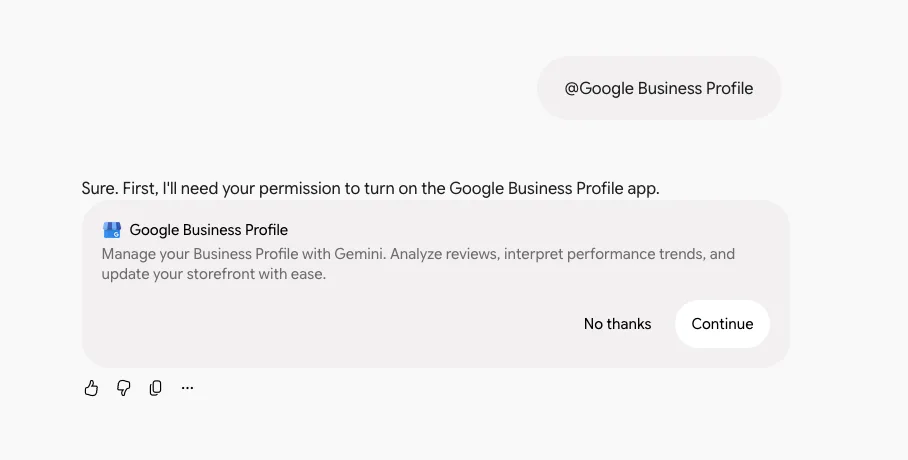
That tip is the whole reason we have screenshots to show you.
The notebook builds its picture of you from two places.
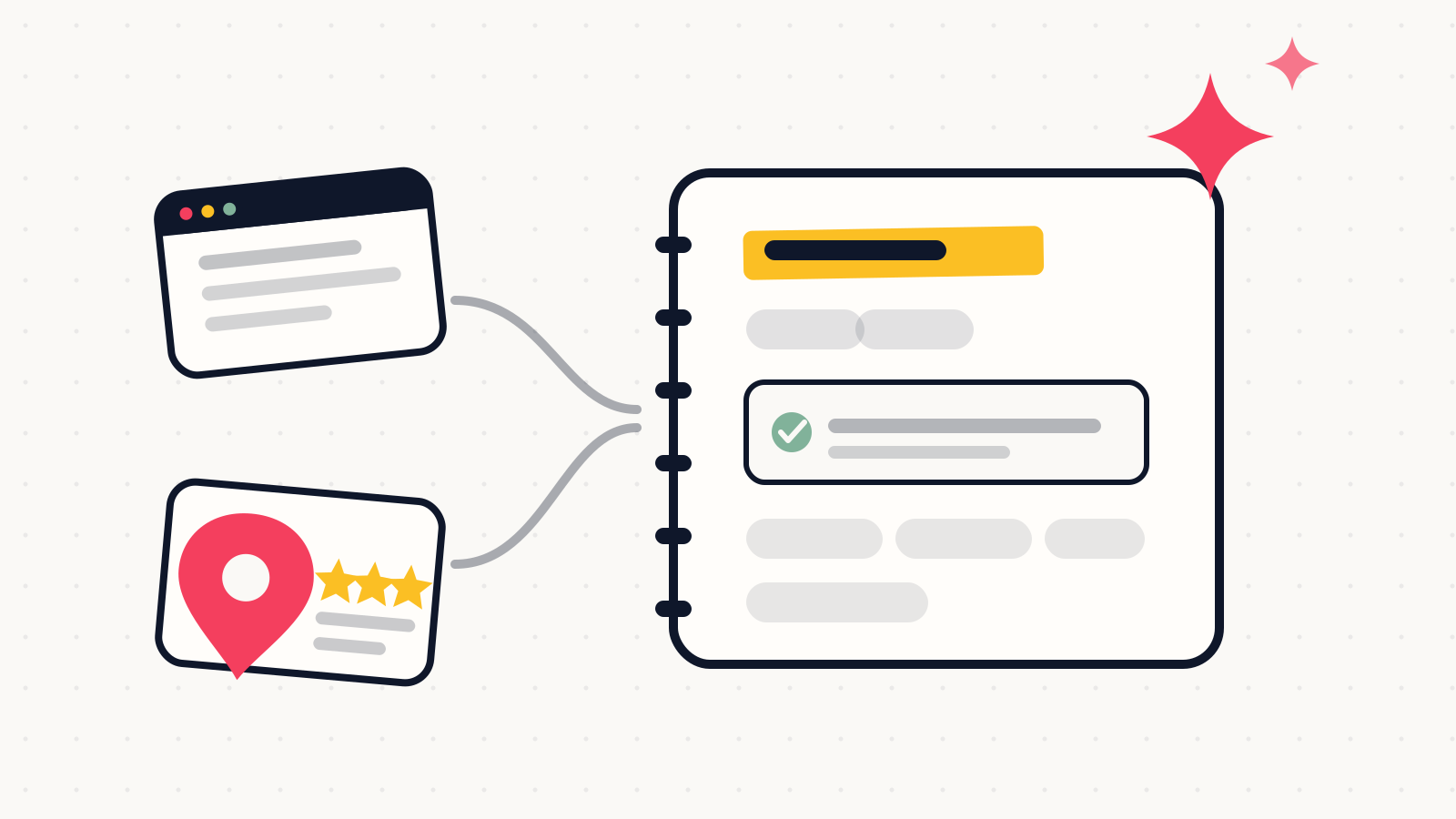
When the notebook does appear, it is built from your Business Profile and your website. That’s not a guess. Google’s setup steps say to "enter or confirm the website URL for your business," and in the notebook video from the Google Business Profile channel the presenter points at the source listed under the business name and describes it as what Gemini has generated as an understanding of the business after looking through the website and the profile.
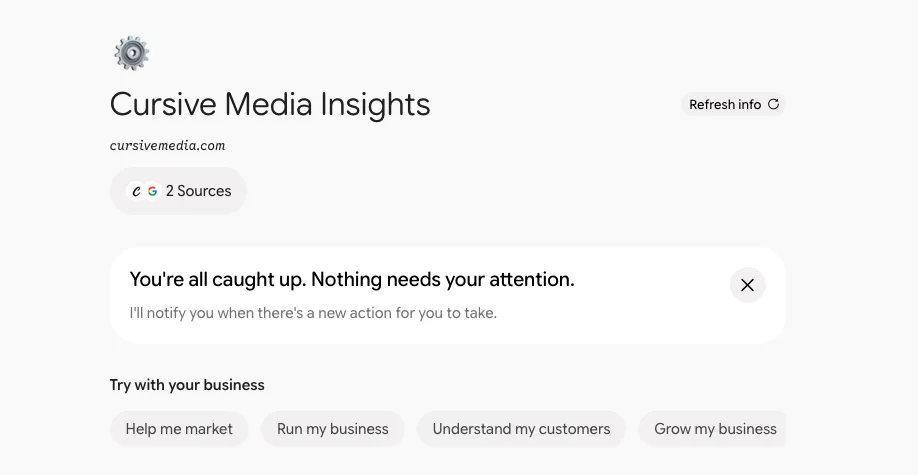
Ours is titled "Cursive Media Insights," with cursivemedia.com under it and a Sources chip. Click it and there they are: our website, our Business Profile, and one we added ourselves, a doc of the search keywords Gemini pulled from the profile. Google seeds the first two. Anything after that is yours to add.
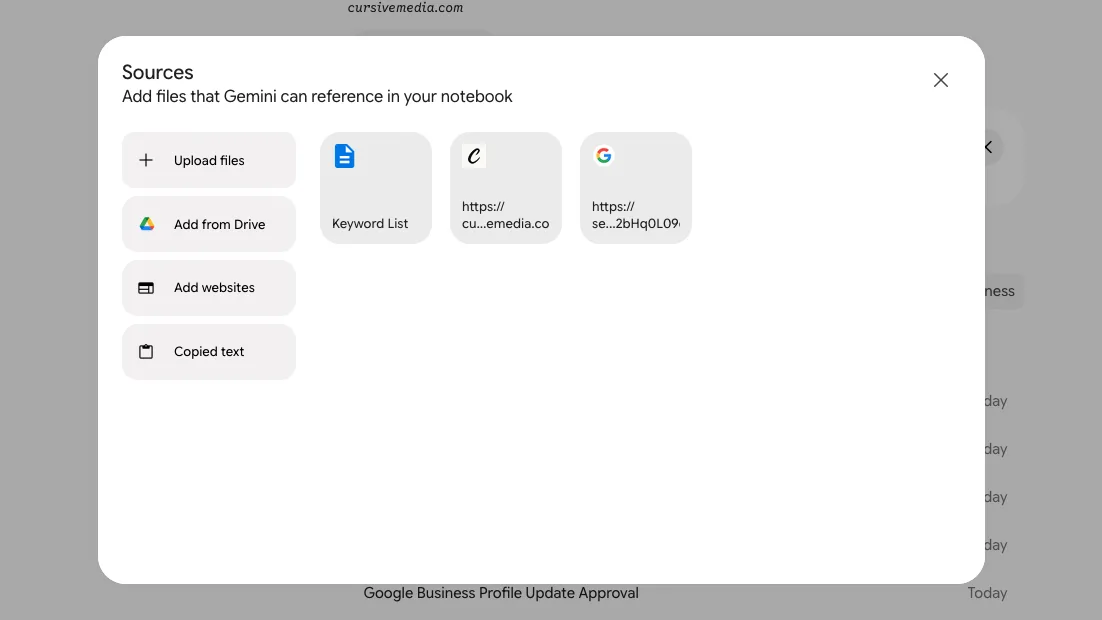
Click either source and it opens as plain text in an edit box. Ours came up as a headed list of what we do: Houston website design, web and app development, website redesign, workflow automation, Zapier, and on down the page, matching the service pages on our site. That text is what Gemini is working from when it answers about Cursive, and the box has a Save button. You can change what it thinks you are.
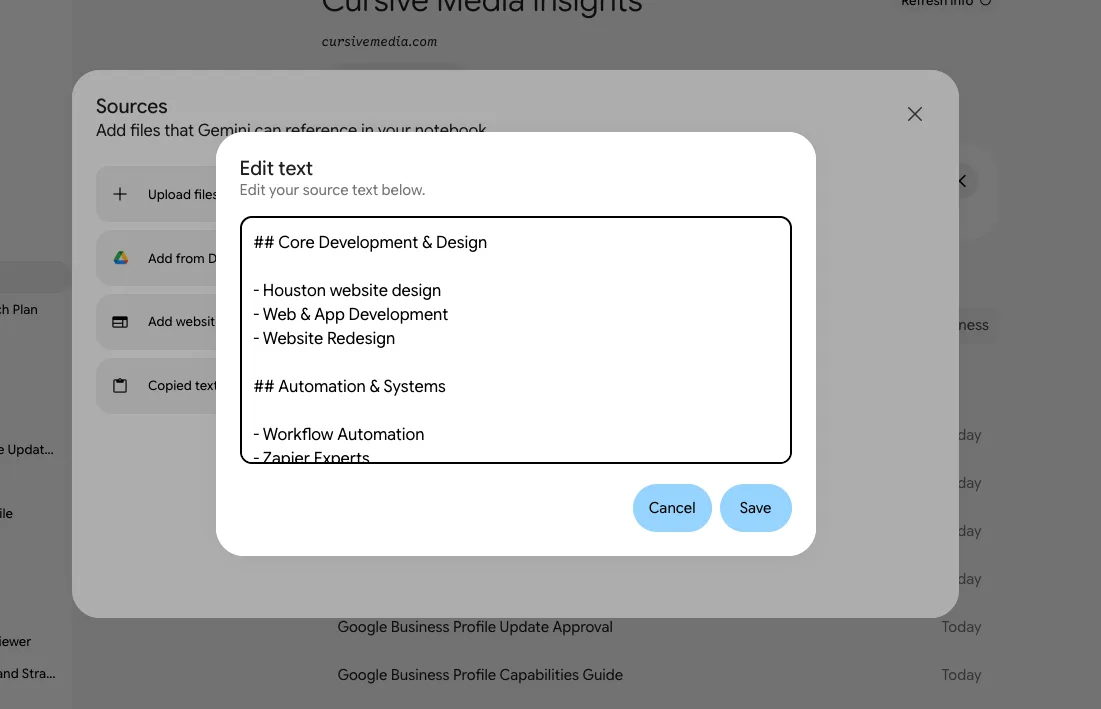
That chip is worth more attention than anything else in the notebook, and almost none of the coverage we read stops on it. Everything Gemini says about your business in this notebook comes from those sources, and the two Google puts there are the profile and the site. If its suggestions describe you well, the profile and the site agree and say enough. If they describe a business you don’t quite recognize, one of those two is telling Google something wrong, and you now know which pages to open.
The notebook also takes documents. The June bulletin says you can import spreadsheets and presentations for more context, and the video shows it producing a positioning analysis from your reviews, a three-month growth plan, and a week of social captions. Those are the demo’s showpieces. The source card and the attention list are the useful part.
The attention list is the easy part. Do it.
At the top of the notebook is a "needs your attention" section. In Google’s video it flags reviews and feedback waiting for a reply, a profile post you haven’t made, and profile information that’s missing. The Help Center adds an exterior photo and a look at your performance to the list of suggested actions. Ours, the day we connected, said "You’re all caught up. Nothing needs your attention," which is what you’d hope for on a profile that answers its reviews and had just been given three posts.
Everything on that list is a five-minute job, and you should do all of it before you read another word about Gemini.
Answer every review, every time. Gemini will draft it and you’ll paste it, which is fine. We have a full post on how to respond to Google reviews, including the unfair ones. Fill in the missing hours or the description. Add the exterior photo. If it says you haven’t posted in a while, read what posts do and don’t do first, then let Gemini draft one and confirm it.
None of this needs us. That’s the point of the tool, and it’s good at it.
The keyword panel is the part worth staring at.
Ask the connected Gemini what search keywords are driving traffic to your business and it will show you the actual terms people typed into Google Search and Maps before they found you. The same report lives in the profile’s performance section, where the metrics around it are easy to misread. Here it arrives as a plain list.
Put your services list next to it.
Google ranks local results on three things: relevance, distance, and prominence. Distance you can’t change. Prominence is slow. Relevance is Google matching your profile to what someone searched, and it only matches what you told it. So the keyword list is the closest thing Google hands you to a readout of relevance: these are the searches its matching already connected you to. If the terms are the services you sell, the profile is doing its job. If a service you sell is nowhere on that list, Google isn’t matching you to it, and there are two places that can be broken.
When a client isn’t showing up for a service they sell, we look at the profile first. Primary category, secondary categories, the services list. That’s the five-minute check, and Gemini can make those edits for you once you know what to ask for. Then we look at the website, and that’s where the tool stops helping. We wrote up the three factors in detail if you want the whole picture.
What it gets wrong is usually what your website told it.
Put the two previous sections together. The notebook builds its picture of your business from the profile and the site. The keyword panel shows you which searches Google already connects you to. When the picture is off, or the list is missing the work you actually want, the profile is usually the smaller half of the problem.
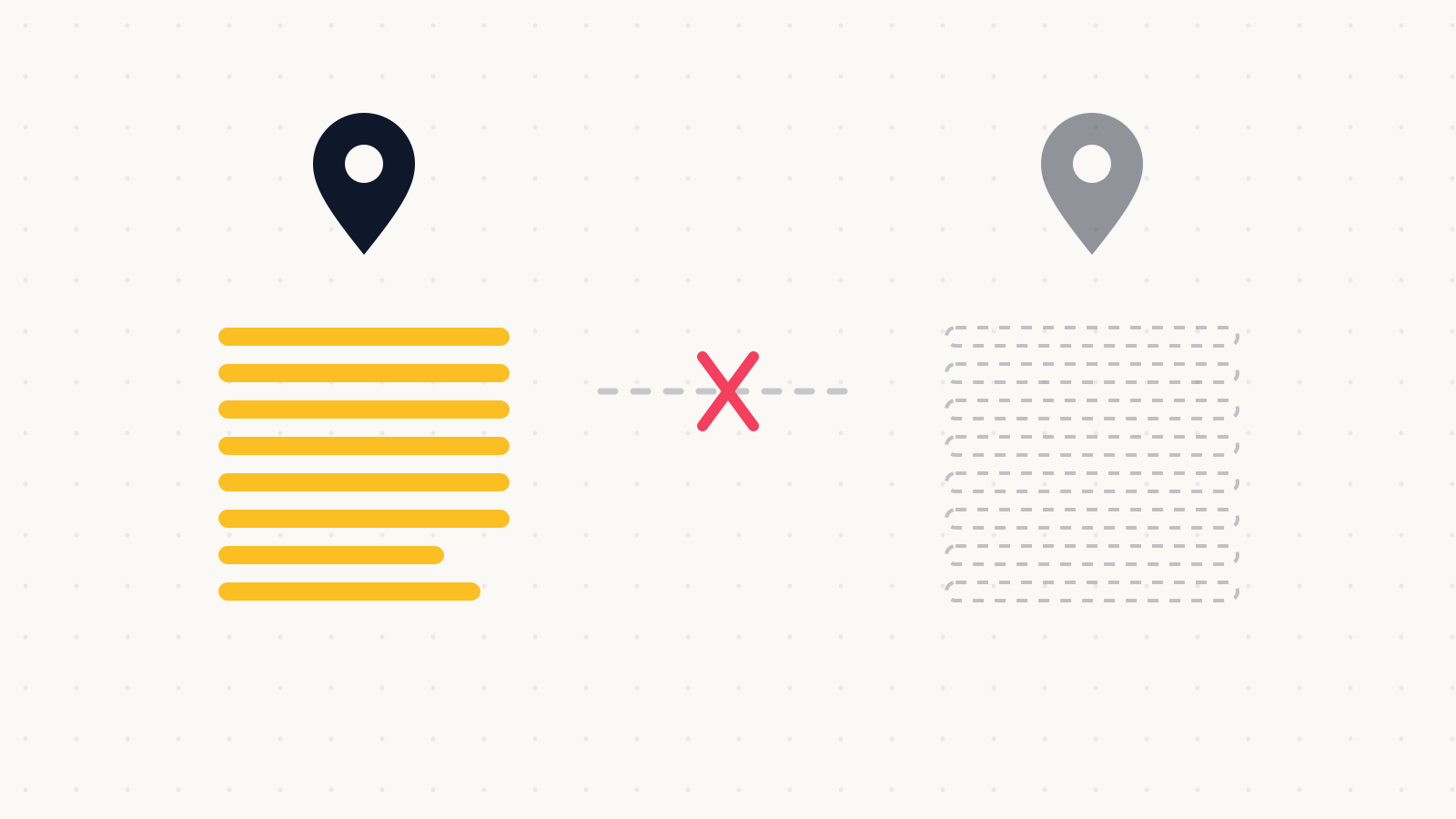
The site is the bigger half. A service that lives only in a photo, a PDF, or a line in the footer isn’t something Google can match. Google’s own August guidance, again as reported by PPC Land, says hours, services, and menus belong on the page as readable text, not baked into images. The same newsletter says its generative features ground on web pages and Business Profile records. We covered what Google says about showing up in AI search from the primary source. Short version: the profile and the site are the two records Google reads, and the notebook is the first place you can see what it concluded from them.
That’s the line between what you fix yourself and what you might want help with. Categories, hours, photos, a reply. That’s you. A site that doesn’t say what you sell, on real pages, in words Google can read, is search work. It starts with an audit of where you stand and the searches you want to win. Bring the keyword list from the notebook and the source card, and you’ve already done the first hour of it.
What it still can’t do.
The tool executes. It does not decide. That’s our read after one run, and it matches what local search practitioners said the week it launched. One profile specialist quoted in PPC Land’s coverage put it this way: clients often don’t know which categories to pick, or why their profile doesn’t appear in the next town over, and "this tool doesn’t provide strategy or analysis. It helps you implement your ideas more quickly. If you don’t know what to enter, you’ll still have the same problem even with Gemini." Another warned that if the profile is messy, AI just moves faster with messy inputs.
Handy, but you still have to know what to tell it.
To be fair to Google, that’s how it’s built and how Google describes it. Every change goes through the same API and the same checks as a manual edit. Nothing posts without a confirmation. It is a very good pair of hands for the chores of running a profile, and the chores are the half most businesses skip.
Before you connect: the data question.
The connect dialog is specific about what it does. Gemini will "access and manage your Google Business Profile data, like your business info, reviews, and performance metrics," and it will "share information from this chat, including your prompts, Gemini’s responses, and the general area of your location if relevant." It notes that when Gemini answers using other connected apps, your profile content may be shared if it’s part of the conversation.
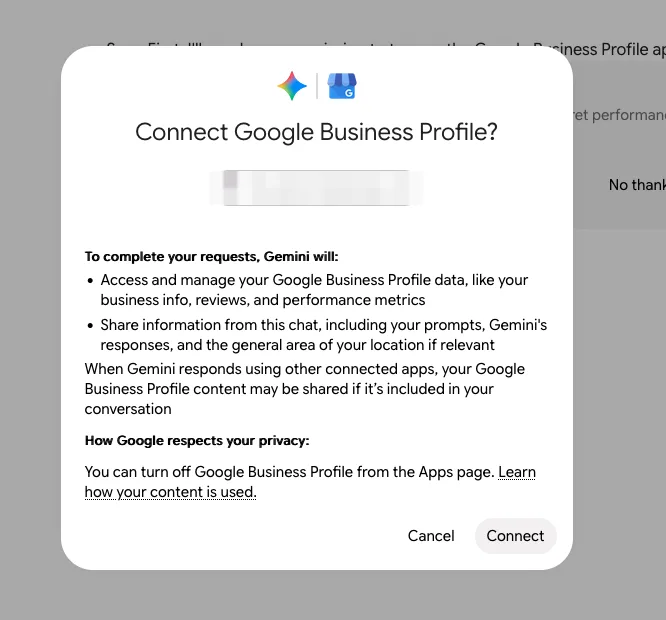
Keep Activity has to be on, which means your chats are saved to your Google account. You can turn the app off from the Apps page at any time. What Google retains after you disconnect is a question its Privacy Hub answers, not this post. If you’re deciding whether a reviews feed and a performance report are things you want inside an AI chat at all, we wrote about putting customer data into AI tools and the answer depends on what’s in it.
What to do this week.
- Run the six setup steps above. If it stalls at the permission card or the notebook offer, the five reasons are why. A missing banner, the tag fixes. The rollout, you wait out. The other three you can’t change today.
- Open the notebook and click the Sources chip. Open each source and read the text. If it lists services you don’t sell, or misses ones you do, fix it there and then fix the page it came from.
- Clear the attention list. Replies, hours, photo, post.
- Ask for your search keywords. Put the list next to your services.
- If the card is wrong or the list is missing what you sell, the profile is a five-minute fix and the site is not. Book a scoping call and bring both screenshots. Twenty minutes, and you’ll know whether it’s the profile, the site, or neither.
John "Holliday" Mahlow
Founder, Cursive Media