

Why you should respond to every Google review.
Your reply isn’t written for the reviewer. It’s written for the person reading the exchange while they decide whether to call you, and that changes everything about whether you bother.
Founder, Cursive Media
- Read time
- 5 min read
- Updated
TL;DR
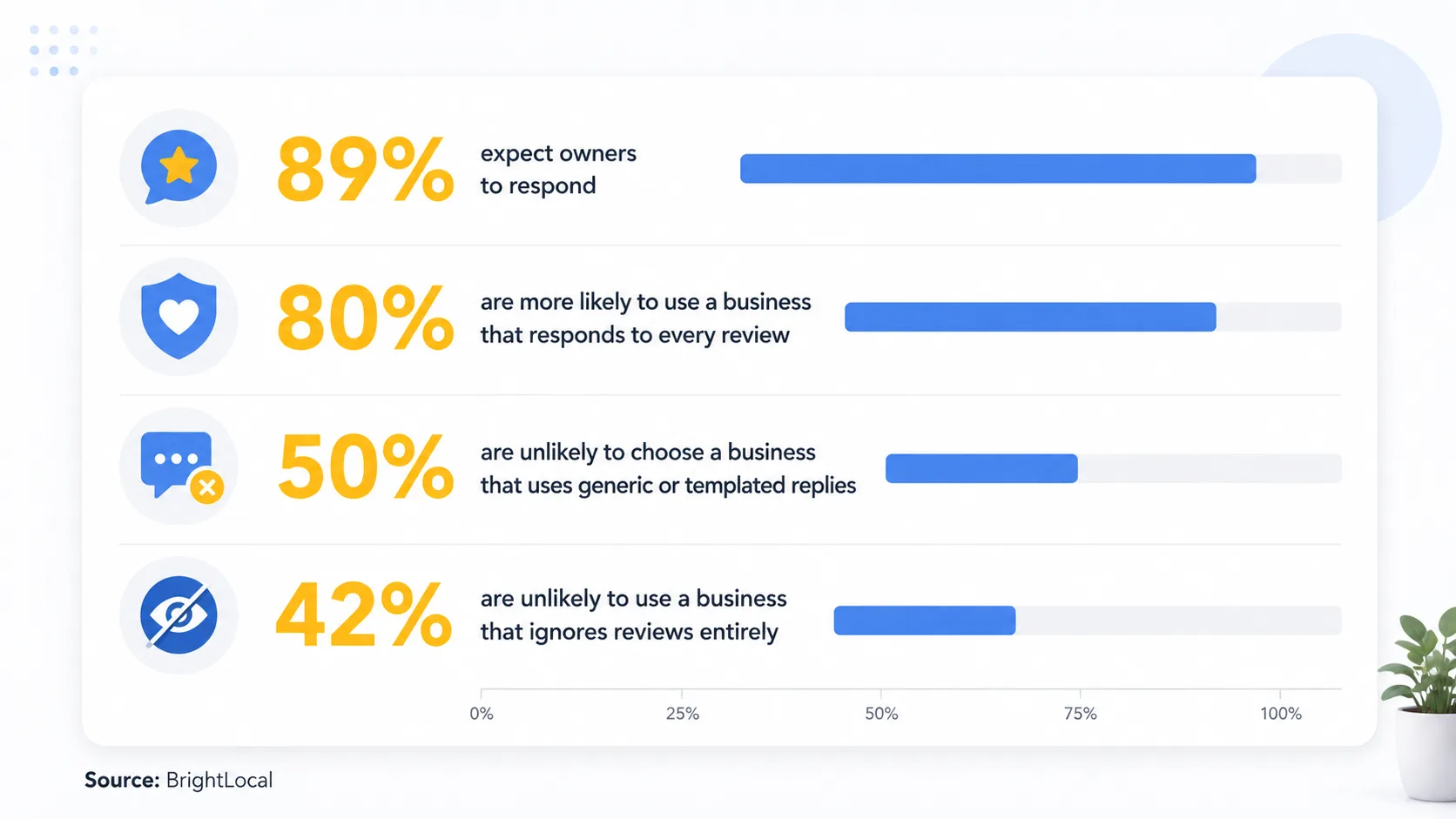
- Reply to every review, 5-stars included, but never paste the same reply twice. BrightLocal’s 2026 survey found 89% of consumers expect owners to respond, and 50% are put off by generic or templated replies.
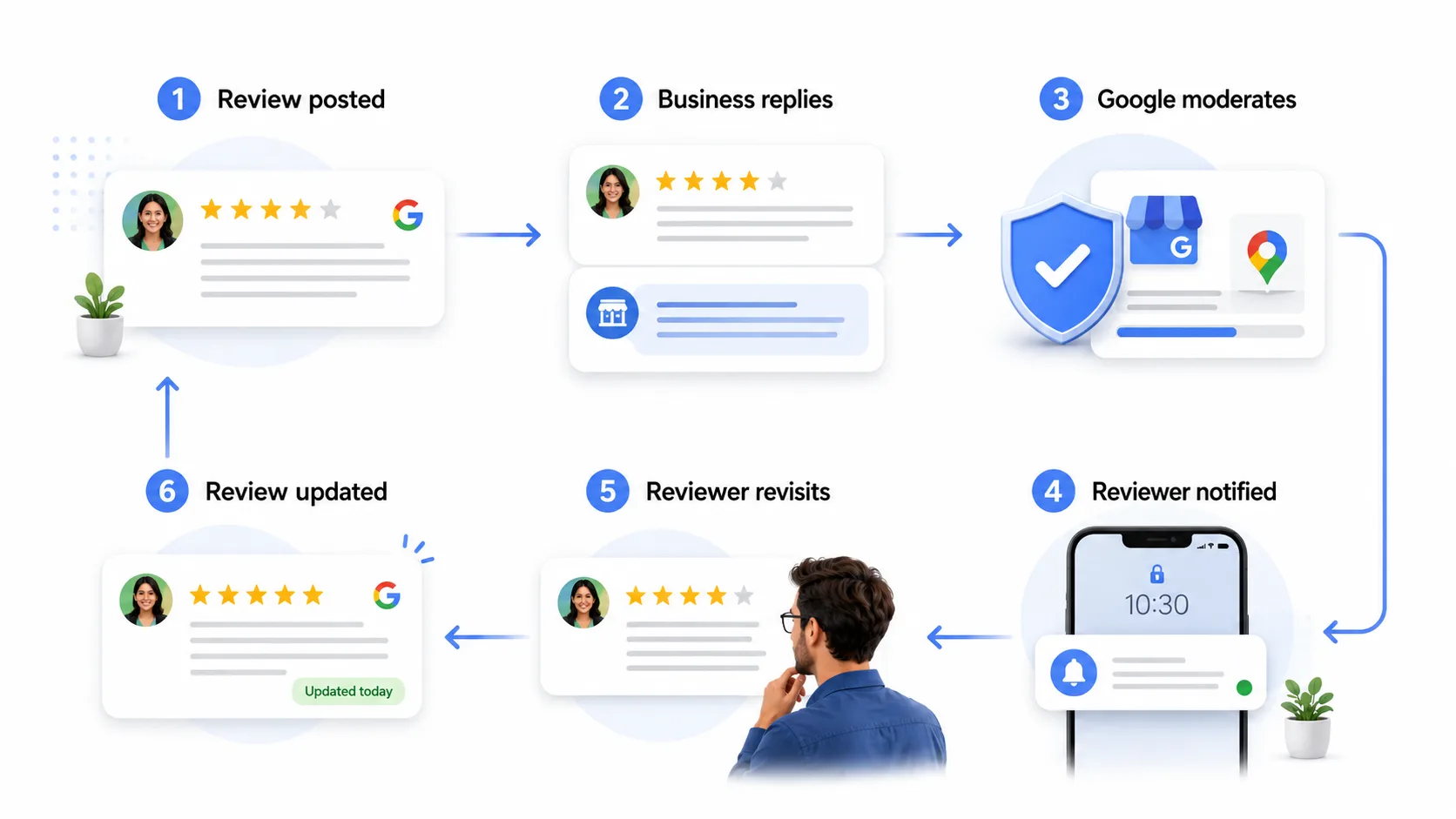
- Your reply notifies the reviewer, who can edit a negative review after reading it. An edited review resurfaces as your most recent one.
- Google lists replying as a best practice but doesn’t say how much it moves your map ranking. Do it because the next customer reads it.
Most owners know they are supposed to respond to their reviews. Fewer do it, and it is easy to see why: it feels like writing to someone who has already made up their mind.
That instinct is right about the reviewer and wrong about the audience. The person who left the review is done. They had the experience and said their piece. The people your reply is actually for are the strangers reading the exchange while they decide whether to call you.
One reply, written to one person and read by everyone who looks you up afterward. That is the whole argument, and everything below follows from it.
The silence is the loudest thing on your profile
An unanswered review does not read as neutral. It reads as nobody being home.
BrightLocal’s 2026 Local Consumer Review Survey, which polled 1,002 US consumers, found that 89% of them expect business owners to respond to reviews. More pointed: 42% said they are unlikely to use a business that never replies. That is not a preference, it is close to half your prospects filtering you out on a signal you control completely.
Google states the expectation too, listing it as a best practice in plain language: "Reply to reviews: Show customers that their feedback matters."
Think about what a prospect is actually doing on that page. They are not reading your reviews to total up the stars. They are looking for a reason to rule you out, and a wall of unanswered complaints is the easiest one available.
A reply is the only thing that reaches backwards
This is the part most owners have never been told, and it is the strongest reason to answer the bad ones in particular.
Google’s documentation on replying to reviews states: "The person who wrote the review is notified when you reply. Customers can still change their review after reading your reply. If they change their review, the date on their review will change to show when the latest update was made."
Read that twice. Your reply lands in the unhappy customer’s notifications. If it moves them, they can edit what they wrote. When they do, that review resurfaces as your most recent one.
We have watched this happen more than once: a customer goes back and changes a negative review after the business answered it properly. Not every time, and not most of the time. But no other reputation tactic can touch a review that already exists. You cannot collect your way out of it. You cannot out-rank it. Outside a genuine policy violation, you cannot remove it either. A reply is the only lever that reaches back.
One practical note before you wonder why nothing posted: replies go through moderation first. Google says they "usually take up to 10 minutes to review, but sometimes a review can take up to 30 days."
Answer all of them
When a client asks whether they really have to respond to every review, the answer is yes. All of them, every time. The 5-stars, the 3-stars, the ones that barely say anything.
There is one way to get this wrong, and it is the way most businesses get it wrong: answering all of them with the same words. The same BrightLocal survey found that generic or templated replies put off 50% of consumers, "who may see them as a sign of subpar customer care." Forty identical thank-yous down the page do not read as diligence. They read as a process nobody is paying attention to, which is the exact impression you were trying to avoid.
Google is direct about this too: "Make your replies count: Instead of sending the same 'thank you' to everyone, focus on reviews where you can share a helpful update or answer a question."
That is not an argument for answering fewer reviews. It is an argument against pasting. The rule that satisfies both is simple: every review gets a reply, and no reply gets used twice. Name the technician or the job. Reference the thing that actually happened. If a reply could sit under any other customer’s review without changing a word, it is not finished.
Here is the difference, in a pair we wrote for this post. Neither is from a real profile.
- Weak: “Thank you for your review! We appreciate your business.” It fits under every review on the page, so it says nothing about this one.
- Strong: “Thanks, Maria. Glad Luis got the water heater swapped before your guests arrived Friday. We’ll pass this along.” The reviewer’s name, the job, who did it, and three short sentences.
What Google asks for, in four lines
Google publishes its own guidance on writing replies, and it is short enough to be worth repeating verbatim.
- Keep it short. "Customers value direct and honest responses. If a reply is too long, people might stop reading before they get to the main point."
- Make it personal. "Address the reviewer by name and acknowledge their specific feedback."
- Be prompt. "A prompt response shows that you value your customers’ feedback and are committed to high-quality service."
- Do not sell. "Be conversational, not promotional: Your reviewers are already customers, so avoid using your response to offer deals or promotions."
The wording for each star rating, including the unfair ones and the ones that are flatly untrue, is a longer job and it has its own page: how to respond to Google reviews.
What Google says about reviews and ranking
Google’s page of tips to improve your local ranking does list replying: “Positive reviews and helpful replies can help your business stand out.” When the same page explains how ranking works, it names three factors: relevance, distance, and prominence, and the review inputs under prominence are how many reviews you have and how good they are. Google recommends replying. It does not say how much a reply moves you up the map, and neither does this post.
Count and rating are the collection half of the job, and they are the argument behind your Google rating being your real homepage.
Respond because the next customer reads it. That reason does not expire when an algorithm changes.
Why most businesses stop after a good start
We have watched businesses start answering their reviews, hold it for a stretch, and then go quiet.
What holds is unglamorous. An alert the moment a review posts. A different path when it is negative. A draft waiting instead of a blank box. One named person who owns it, not whoever sees it first.
There is one more decision in there, and most vendors make it for you without mentioning it: whether AI drafts the reply at all. We ask. Some clients want a generated draft they read and approve; some want nothing generated anywhere near their profile. Both are fine answers. What is not fine is the version nobody chose, where a model quietly posts the same warm paragraph under every review. That is the exact sameness Google tells you to avoid, and the thing half of consumers say puts them off a business.
That wiring is the same event-driven plumbing as collecting the reviews in the first place, and it is what reputation management actually means once you strip the word down.
Want to see what a stranger sees first? The free Google Business Profile audit shows your rating, your review count, whether the profile is claimed, and which basics are missing. No email needed.
If your profile has a stack of unanswered reviews sitting in front of every prospect who looks you up, book a strategy call and we will look at what it takes to clear it and keep it clear.
Founder, Cursive Media