GoHighLevel vs HubSpot: the two questions that actually decide it.
A GoHighLevel agency compares the two on what the feature grids skip: what your CRM has to model, who operates it, and the custom-object price inversion.
John "Holliday" Mahlow
Founder, Cursive Media
- Read time
- 7 min read
- Written
Every GoHighLevel vs HubSpot comparison you can find is a feature grid, and most of them are accurate. That is the problem. Both platforms send email, book appointments, score leads, and hold a pipeline, so the grid comes out roughly even, and you finish reading it exactly as undecided as you started.
Two questions decide this, and neither one appears on a grid: what your business has to model, and who is going to operate the thing on Tuesday morning. Get those right and the feature comparison sorts itself out.
A disclosure first, because it changes how you should read the rest. We build on GoHighLevel every day, and the links to it below are partner links. That is also why the section telling you to buy HubSpot instead is in here.
The prices are not comparable, and that tells you something
GoHighLevel charges $97 a month for its starter tier, $297 for unlimited sub-accounts, $497 for the agency SaaS tier. Users and contacts are unlimited on all of them. HubSpot gives away a free tier capped at two users and 1,000 contacts, sells Starter seats at roughly $20 per seat per month billed monthly, and prices Marketing Hub Professional at $800 a month for three core seats, $45 for each seat after that, with a mandatory $3,000 onboarding fee. All figures at the time of writing; both vendors move their tiers.
Comparing those numbers directly is a waste of an afternoon. The shapes are what matter, because each one encodes an assumption about your business.
Per-seat pricing assumes headcount is the thing that grows. It is built for a company that hires marketers, and it charges you accordingly as you do. Flat pricing with unlimited users assumes the opposite: that one or two people configure a system many people merely touch. That is the local-business shape, and it is the reason GoHighLevel’s pricing tends to beat a stitched-together stack for a nine-person company.
The $3,000 onboarding fee is the most honest line item in either catalog. HubSpot knows Professional does not configure itself, so they charge for the configuration. GoHighLevel assumes you or your agency will do that work, and charges nothing for it, which is a bargain right up until nobody does it.
Fork one: what your CRM actually has to model
This is where the decision usually lives, and it is the part no comparison article covers, because it takes reading the documentation rather than the pricing page.
A contact can belong to exactly one company
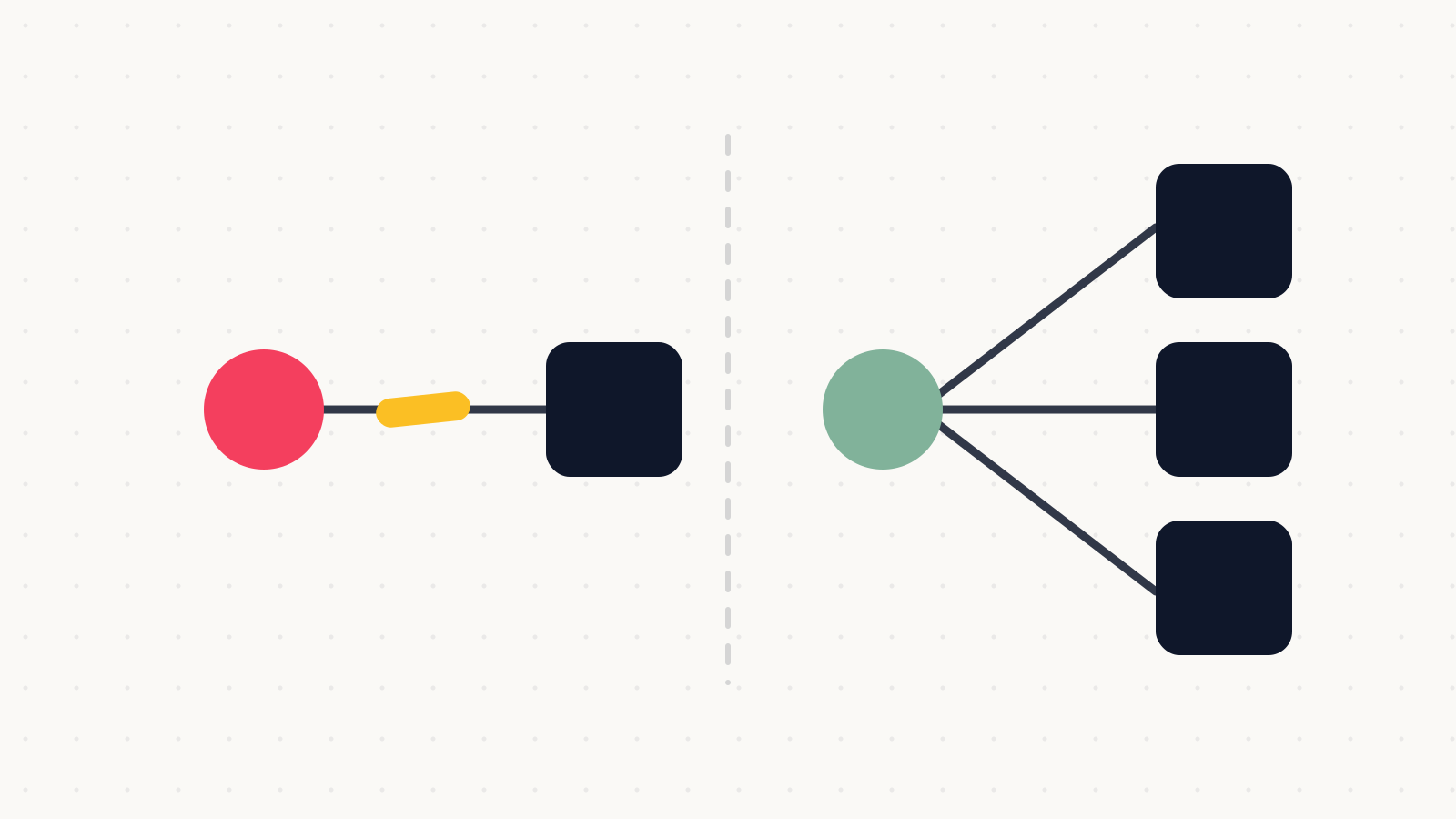
HighLevel’s documentation is explicit: a contact can be associated with only one company at a time. For a homeowner booking a roof inspection, that constraint costs you nothing, because she is one person at one address and always will be.
It costs you plenty the moment your customers are organizations. The property manager who holds three LLCs, the franchise owner with four locations under separate entities, the bookkeeper who is the billing contact for eight of your clients — each of them is one contact record that needs to sit under several companies, and the platform will let you pick one. Whatever you pick, your reporting is now wrong in a way that is tedious to unwind later.
HubSpot models that natively. Contacts associate with multiple companies, associations carry labels so you can distinguish a decision-maker from a billing contact, and the reporting follows the relationships. If your sales motion involves buying committees, that difference is worth more than every other row on the grid combined.
Custom objects: the price curve runs backwards
A custom object is how a CRM stops being generic. An insurance agency needs Policies. A property manager needs Units. A dental practice needs Treatment Plans. Without one you end up with forty custom fields bolted onto the contact record and a spreadsheet running the real business alongside it.
Here is the fact that should reorder most people’s shortlist: HubSpot gates custom objects behind its Enterprise tiers. Marketing Hub Enterprise starts at $3,600 a month for five seats with a $7,000 onboarding fee. GoHighLevel ships custom objects on its plans as documented, starting at the $97 tier, and they associate with contacts, companies, opportunities, and each other, with workflow triggers, form capture, and dashboard reporting attached.
Same structural capability, thirty-seven times the entry price.
The platform the industry treats as the scrappy agency tool gives you a modelable CRM for less than a hundred dollars a month. The platform everyone calls the grown-up option asks for Enterprise money to do the same job. Nobody writing these comparisons mentions it, and it is the most expensive thing on this page to get wrong.
What you get for that price: unfinished plumbing
Read the association limits before you commit an object model to GoHighLevel. At the time of writing its documentation caps you at 10 labels per object pair and 1,000 linked records per side of an association, does not support bulk importing associations, and lists API and automation support for associations as coming soon. Custom objects also sit outside the contact-only features, so bulk email and marketing campaigns do not run against them.
None of that is fatal. It is the difference between designing a data model and shipping one.
If your migration involves ten thousand historical policy records, that bulk-import gap is your whole project plan, and it is the kind of thing you discover in week three of a build rather than week one of a demo. Check the current state of those limits the week you decide, not the week you read this.
Fork two: who runs it on Tuesday morning
Seat pricing changes behavior, not just invoices. When seats cost money, small teams share one login, and within a quarter your attribution is fiction because every record is owned by "office@". GoHighLevel’s unlimited users removes that particular own-goal, and it is a bigger deal than it sounds when you are trying to work out which of your two techs actually closes the estimates.
Unlimited users buys you nothing if nobody owns the configuration. The most common failure we see is not choosing the wrong platform; it is choosing correctly and then leaving it half-built, which is the non-use problem that kills CRM projects regardless of vendor. GoHighLevel is a wide platform, and wide platforms punish part-time owners — the honest complaint about it has always been overwhelm rather than capability, as we have written before.
So answer the operator question out loud before you compare anything. If the answer is "one of us, in the evenings, sometimes," pick the narrower tool or hire the operator. Both of these platforms will happily bill you for a system nobody is running.
Where each one genuinely wins
| Your situation | Better pick | Why |
|---|---|---|
| Local service business, phone and SMS drive the follow-up | GoHighLevel | The phone system, calendar, and CRM are one product, so the follow-up is native rather than synced |
| B2B where one person sits across several entities | HubSpot | Multiple company associations with labeled roles; GHL allows one company per contact |
| You need a custom object and cannot justify Enterprise | GoHighLevel | Custom objects from the $97 tier versus HubSpot Enterprise pricing |
| A marketing team of five or more living in email and deals | HubSpot | Per-seat permissions and reporting built for staff, plus documentation that answers |
| Agency reselling the platform under your own brand | GoHighLevel | Sub-accounts and SaaS mode; HubSpot has no equivalent |
| Migrating years of relational history in bulk | HubSpot | GHL does not support bulk association imports at the time of writing |
When we tell people not to buy GoHighLevel from us
Genuine B2B, contacts spread across multiple entities, reporting that depends on those relationships. Buy HubSpot. Start on the free tier, move up to Starter when it pinches, and skip us entirely. The one-company constraint will annoy you weekly, the association API is not finished, and no amount of clever configuration on our end changes either fact. We would rather say that on a discovery call than onboard you into a refund.
The other honest answer is neither. If the entire job is a monthly newsletter and a contact list, buy an email tool for $30 and spend the difference on something that generates leads. We have laid out the wider field of options, including the vertical platforms that beat both of these for specific trades.
Disclosure: links to GoHighLevel in this article are affiliate links, so we earn a commission if you sign up through them. It costs you nothing extra, and it did not write the paragraph telling B2B readers to buy HubSpot.
Bring your object list, not your feature list
Before either demo, write down the things your business tracks that are not people: jobs, policies, properties, units, memberships, matters. That list decides the platform faster than any grid, because it is the one thing software cannot fake its way through.
If you want a second opinion on that list from people who build on GoHighLevel and will still tell you when it is the wrong answer, book a strategy call and bring it.
John "Holliday" Mahlow
Founder, Cursive Media