Do you actually own your website?
Ownership of a website is four separate questions with four separate answers, and most businesses find out which ones they got wrong on the day they try to leave.
John "Holliday" Mahlow
Founder, Cursive Media
- Read time
- 5 min read
- Written
Ask a business owner whether they own their website and you get an immediate yes, usually with a slightly puzzled expression at being asked.
Ask the same person to move it somewhere else by Friday and the expression changes. Nothing here is legal advice, incidentally, and if you have a live dispute the person you need is an attorney rather than an agency.
Four questions in a coat
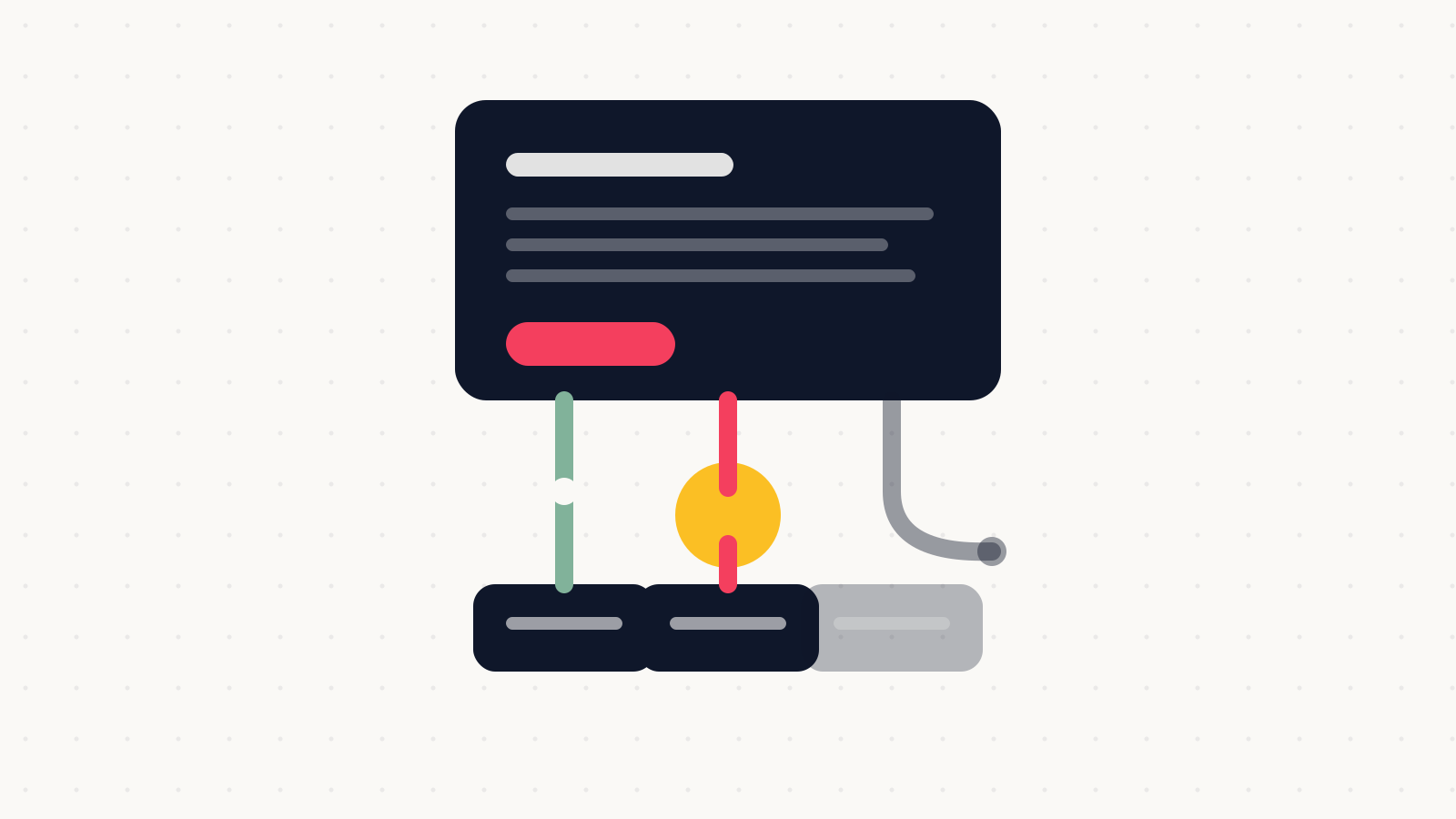
What people mean by the website is at least four things, and they can be owned by four different parties without anybody having done anything underhand.
There is the work itself, meaning the design and the code. There is the domain. There is the platform or hosting account the thing runs on. And there is the content, meaning your photographs and the words. Businesses discover the answers vary by layer at exactly the wrong moment, which is the week they decide to leave.
The layer nobody checks
Copyright in the design and the code is the one that surprises people, because the invoice feels like it settled the matter.
The US Copyright Office describes a work made for hire as either a work prepared by an employee within the scope of their employment, or a work specially ordered or commissioned for certain uses, if the parties expressly agree in a written instrument signed by them that the work shall be considered a work made for hire. It also states that the employer is the author of a work made for hire.
Read the commissioned route carefully. It has two conditions rather than one. The use has to fall within the categories the Copyright Office specifies, which are limited and worth reading there rather than in a summary, and there has to be a signed written agreement expressly saying the work is made for hire.
Paying somebody is not one of the conditions.
That is the whole surprise, and it explains why the question worth settling is not whether you paid. It is what the paperwork says, which is a document most owners have never reread since signing it.
The other three are simpler and just as forgotten
The domain is a registrar account, and whoever holds that account holds the domain regardless of whose name is in the contract. The same is true of the DNS sitting underneath it. That one is quieter than the domain, and it is what actually decides where your traffic goes.
The platform is a subscription. Owning your content on a proprietary builder does not mean the site can leave with you, and what it costs to walk away is a question with a real number attached that almost nobody asks before signing up.
The content is the layer you are most likely to genuinely hold. Protection is automatic on creation and publication is not necessary for it, so the photographs you took and the words you wrote are yours without anybody filing anything. If a copywriter produced those words, the question from two sections ago applies to them exactly as it applies to a designer, and the answer is just as likely to be sitting unread in an email attachment from 2021.
Ask before, not after
All of this is cheap to settle at the start and expensive to settle at the end.
Before commissioning anything, ask one question and listen to how readily it gets answered: if we part company in two years, what exactly do I walk away with. A good answer names the four layers without being prompted. A vague answer is itself the finding, and it costs nothing to hear it now.
The same applies to the accounts around it, which is a list worth writing while nothing is wrong rather than during a handover.
Including us
We build websites, so this is a question you should put to us as readily as to anybody else, and we would rather you asked it early.
A business that cannot leave is not a client relationship, it is a hostage situation with invoicing, and it tends to produce exactly the standard of work you would expect from a supplier who knows you are stuck.
Every site we build is handed over across all four layers, because a business that cannot leave is not a client relationship. If you are about to commission a site, or you are already unsure what you hold, book a strategy call. Working out which of the four layers you actually control takes about fifteen minutes.
John "Holliday" Mahlow
Founder, Cursive Media