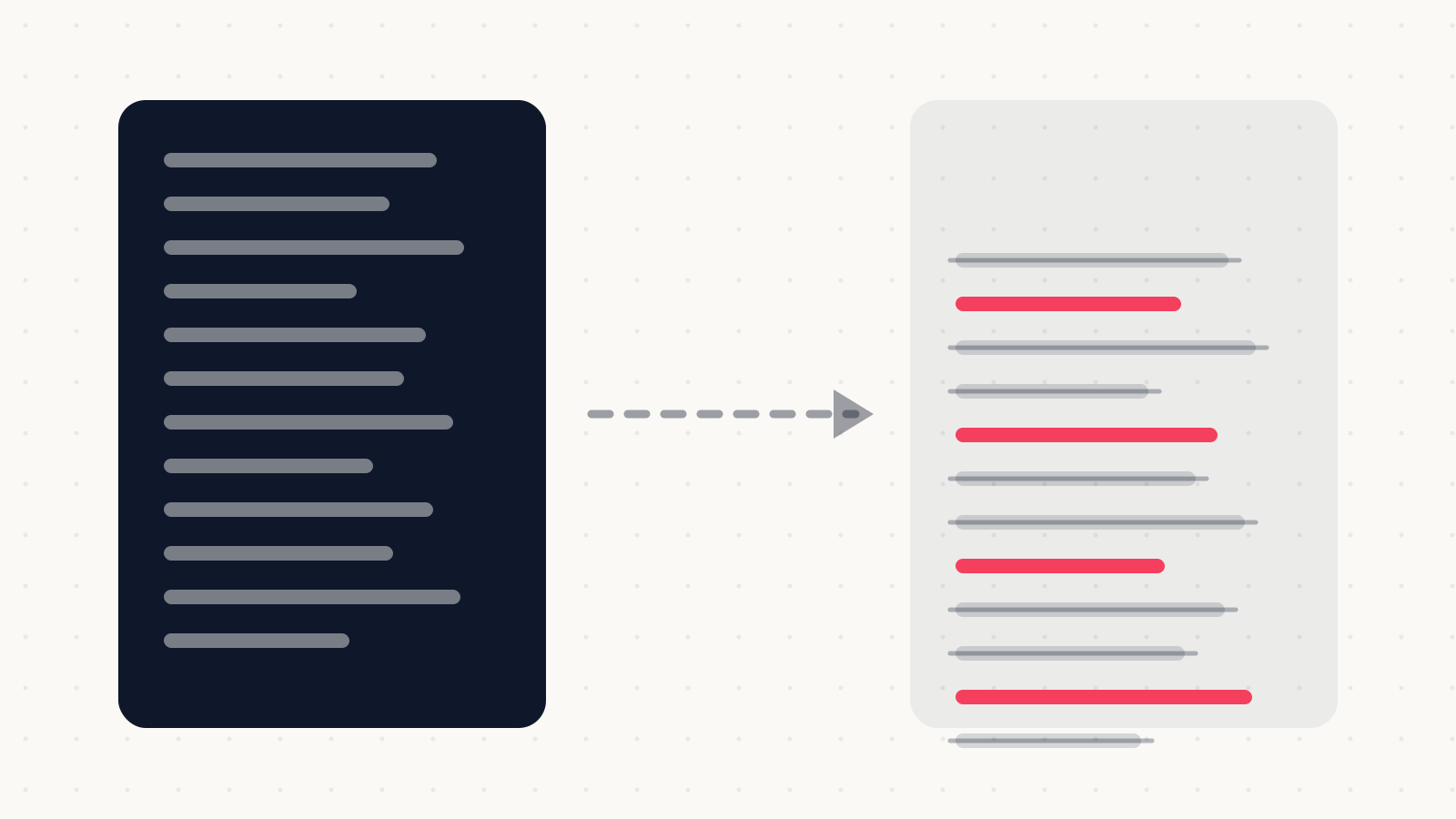

A competitor copied your website. The rankings fear is the wrong one.
Google documents a policy aimed at the copier, not at you. Meanwhile the Copyright Office is clear that some of what feels stolen was never yours to begin with.
John "Holliday" Mahlow
Founder, Cursive Media
Somebody sends you a link on a Thursday afternoon and there are your own sentences, on a different company's site, with the town name swapped.
The first hour of that is not a productive hour. What follows is the order worth working through, and none of it is legal advice, because we are not lawyers and this is a subject where that distinction earns its keep.
Some of it was never yours
Worth knowing before you decide how angry to be. The US Copyright Office states that copyright does not protect ideas, concepts, systems, or methods of doing something, and does not protect facts, ideas, systems or methods of operation, although it may protect the way those things are expressed.
It also says copyright does not protect names, titles, slogans or short phrases, which sit under trademark instead if they sit anywhere.
So a competitor listing the same six services is not the thing. Offering the same warranty is not the thing. Your three paragraphs, reproduced in order with two words changed, is a different conversation, because that is expression rather than idea. Protection itself is automatic on creation, since the Copyright Office is clear that publication is not necessary for it.
The ranking fear points the wrong way
The question underneath the anger is usually whether the copy will now outrank the original.
Google's spam policies address this directly and they are aimed at the copier. Scraping is defined there as taking content from other sites and hosting it with the purpose of manipulating search rankings, and the listed examples include republishing content from other sites without adding any original content or value or even citing the original source, and copying content and modifying it only slightly by substituting synonyms. The stated consequence is that sites which violate the policies may rank lower in results or not appear in results at all.
That is not a promise about your situation and it is not a reason to do nothing. It is a reason to stop treating this as an emergency about your own visibility, which is the framing that produces panicked decisions.
Screenshot before you speak
The most common own goal is sending an angry email first.
The page frequently vanishes within the hour, which feels like winning until you need to show somebody what was there. Capture it properly first, with the date visible. Keep the URLs too. If it does come down immediately, you have lost nothing by having the record.
The routes that exist
Two separate things, often confused. Getting content removed from the web is a matter for whoever hosts it. Getting it removed from search results is a matter for Google.
Google states that it is its policy to comply with notices of copyright infringement pursuant to the Digital Millennium Copyright Act, and it publishes the requirements for a complete notice in its Copyright Help Center. We are deliberately not reciting those requirements here, because getting them slightly wrong is how a notice fails, and the authoritative version is a click away and free.
Anything beyond a takedown, and certainly anything involving your business name rather than your page text, is a conversation with an attorney rather than with an agency.
The part worth sitting with
Look at exactly which passages were taken.
It will be the general ones. Nobody copies the paragraph naming the job you did on a specific street, or your photographs, or the detail about how the pier and beam houses in one neighbourhood behave differently from the slab ones. Those cannot be reused, because they are only true of you. What travels is the interchangeable material, which means the theft has quietly told you which parts of your site could have belonged to anybody.
A competitor who copies a service page full of specifics inherits a page that sells your business to their visitors. That is the version worth building, and it is the same reason a real About page names actual people rather than describing a commitment to quality.
If you have found your copy somewhere it should not be and want a second read on what is worth pursuing, book a strategy call. Often the useful outcome is not the takedown but the rewrite that makes the next one pointless.
John "Holliday" Mahlow
Founder, Cursive Media