That ADA website deadline in your inbox belongs to somebody else.
The WCAG 2.1 AA rule with the 2027 deadline covers state and local government, not your business. The ADA still applies to your site. Both of those are true.
John "Holliday" Mahlow
Founder, Cursive Media
- Read time
- 5 min read
- Written
The email says your website is not ADA compliant, cites a federal deadline, and offers a certificate and a widget for a monthly fee. Or worse, an actual demand letter arrived and the deadline is somebody's attorney.
Two beliefs get sold to small businesses here and they are both wrong, in opposite directions. Sorting out which parts are real takes about five minutes with the Justice Department's own guidance.
None of what follows is legal advice, and if a demand letter is already on your desk, it belongs with a lawyer rather than with a web agency.
The ADA does apply to your website
Start here, because the comfortable version is the wrong one. The Department of Justice states it has consistently taken the position that the ADA's requirements apply to all the goods, services, privileges, or activities offered by public accommodations, including those offered on the web.
If customers can book, buy, or find you online, that is covered ground. Anyone telling you websites are a gray area nobody enforces is describing the internet of about fifteen years ago.
The deadline in the sales email is not yours
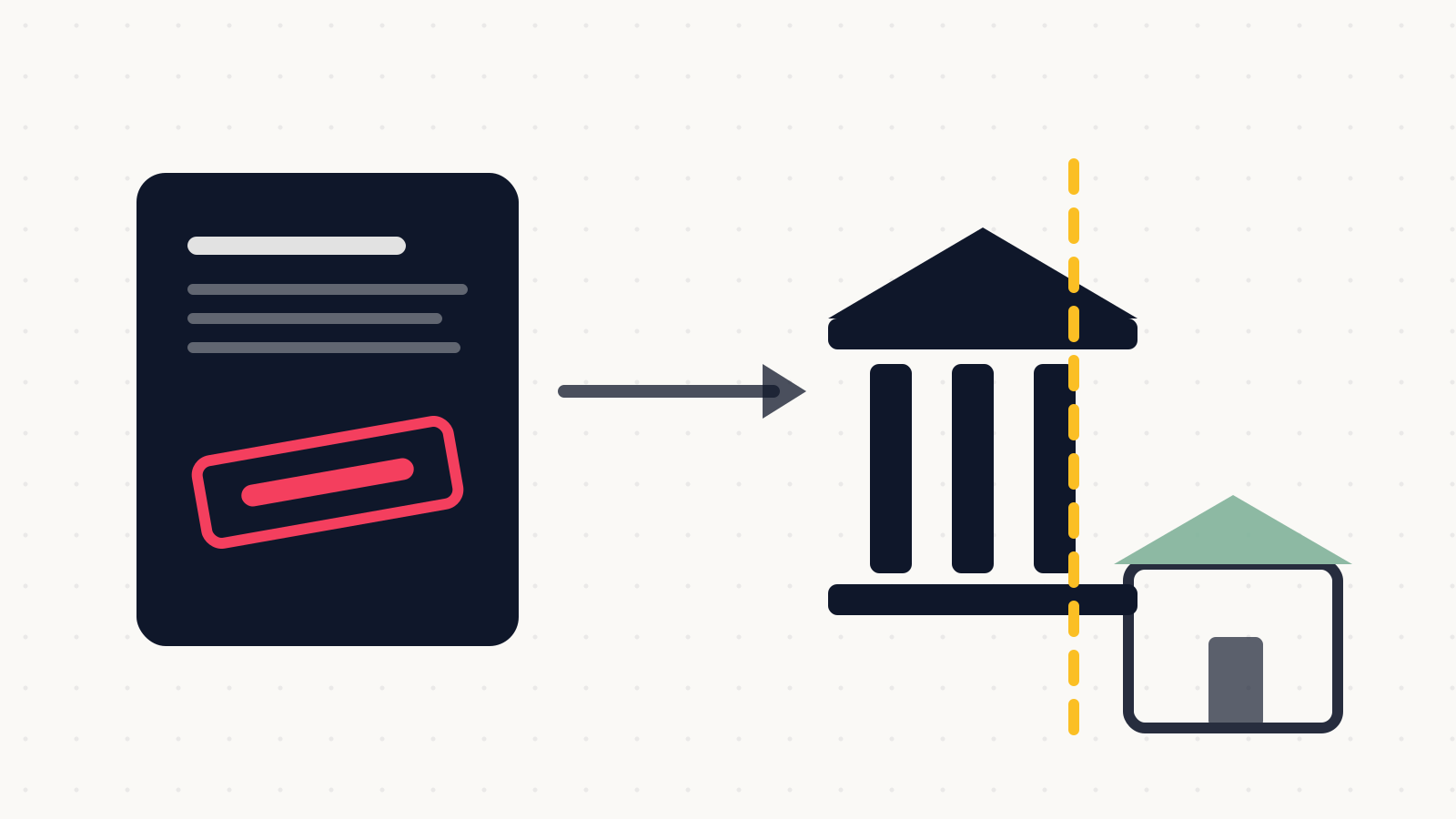
Here is where the marketing gets slippery. There is a real federal rule, finalised in 2024, that adopts WCAG 2.1 Level AA as a binding technical standard with hard dates: 26 April 2027 for entities serving 50,000 or more residents, and 26 April 2028 for smaller ones and special districts.
That rule covers state and local government. Agencies, public schools and universities, courts, transit authorities, public libraries. The DOJ says plainly that it does not apply to private businesses.
So when a vendor quotes you a 2027 compliance deadline for your plumbing company, they are quoting a rule written for city hall.
That does not make them liars, exactly. The dates are real and the standard is real. They are just not the dates or the standard that govern you, and being sold urgency on somebody else's regulation is a reason to look harder at everything else in the pitch.
Why nobody can certify you
For businesses, the DOJ says it does not have a regulation setting out detailed standards. What it says instead is that you have flexibility in how you comply with the general requirements of nondiscrimination and effective communication, but that you must comply.
Outcomes are mandatory. Methods are yours to choose.
Which means a certificate declaring your site federally compliant is certifying you against a technical standard that the government has not issued for you. The badge is a design element. It is not a legal shield, and no vendor can hand you one, because the thing it claims to attest to does not exist in the form it implies.
What WCAG is in this picture
Not a law that binds you, and not something to dismiss either. DOJ points to WCAG and the Section 508 standards as existing technical guidance that helps ensure website features are accessible.
Treat it as the best available definition of "done" rather than as a statute. If you are going to fix your site, fixing it toward a recognized standard is more defensible than fixing it toward a vendor's checklist, and considerably more defensible than not fixing it.
The short list that actually matters
Most small business sites fail in the same handful of ways, and none of them require a rebuild. Text that is too light against its background. Images carrying information with no alternative text. Form fields with no real label attached, so a screen reader announces "edit box" and nothing else. Buttons and menus you cannot reach or operate with a keyboard alone. Video with no captions.
Unplug your mouse and try to book your own appointment. That single test finds more than any scanner will, and it takes two minutes.
It is worth knowing that AI-generated markup is unusually prone to exactly these failures, which is one of the quieter problems with letting a chatbot build the site: it produces something that looks finished and ships unlabeled inputs underneath.
On the widget
Overlay tools promise to fix accessibility with one line of JavaScript, layered over a site whose underlying markup is unchanged. Whatever the tool does at the surface, the DOJ's framing is about whether people can actually use what you offer, and a script cannot supply a label that was never written or restructure a page it did not build.
Judge any such product on that basis, and be skeptical of one sold with a certificate attached.
Accessibility is a build decision rather than a plugin, which is why it sits inside how we approach it rather than on a checklist at the end. If you want the real list of what is broken on your site and what it would take to fix, book a strategy call and we will go through it. Most of it is unglamorous build-quality work rather than a compliance product, which is also why it rarely gets sold to you that way.
John "Holliday" Mahlow
Founder, Cursive Media