Which tasks should a small business give AI?
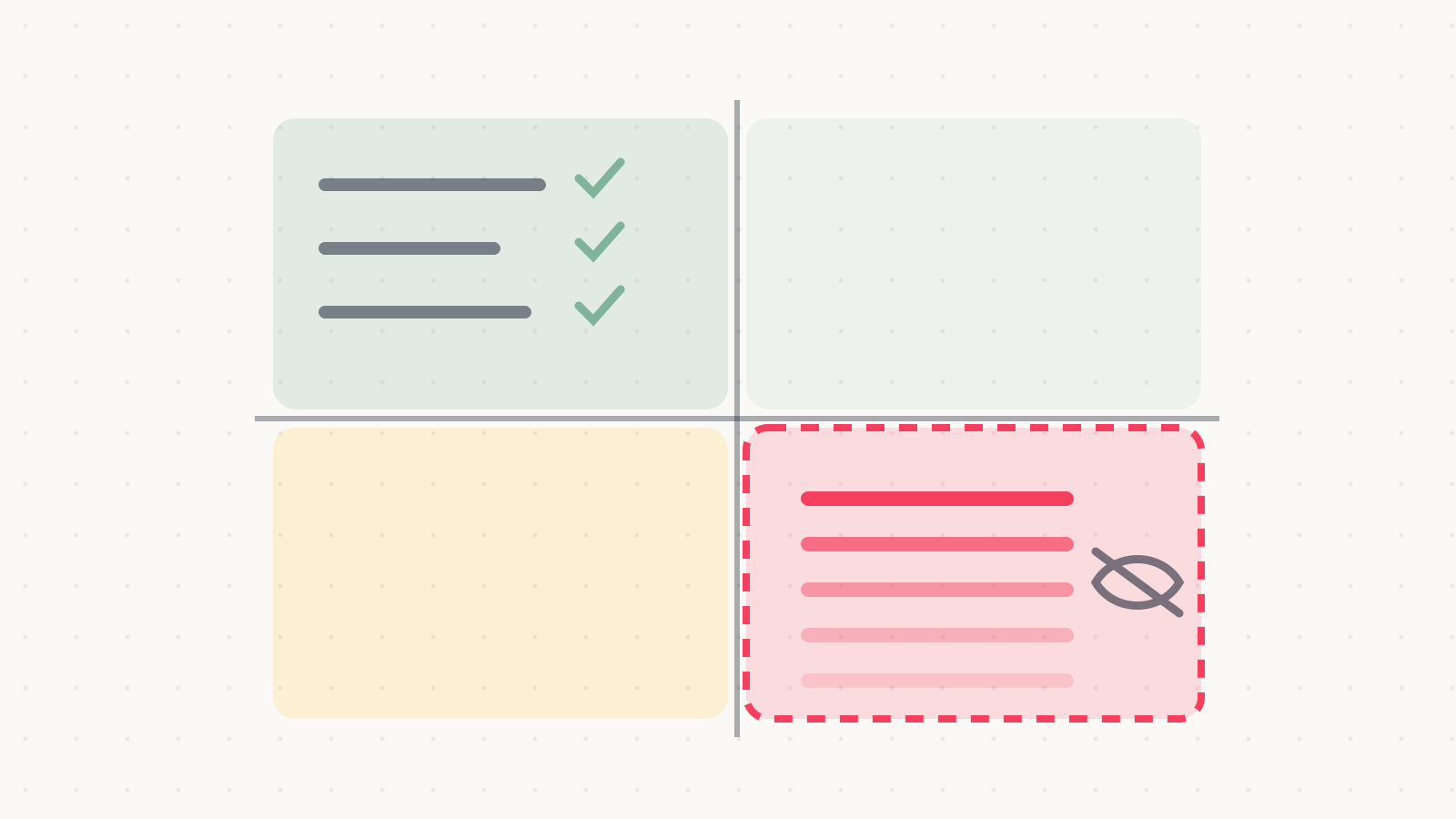
Two questions decide every one of these calls: does a human see it before a customer does, and would anyone notice if it were wrong.
John "Holliday" Mahlow
Founder, Cursive Media
- Read time
- 5 min read
- Written
Most advice here is a list of use cases, which is useful for about a year and answers a question you did not ask.
What you actually need is a rule that still works when the tools change.
Two questions
Ask them about any task before you hand it over.
Does a person see the output before a customer does. And if it were wrong and nobody looked, would anyone find out.
Almost every sensible use of AI in a small business is a yes to the first. Almost every disaster is a no to both, running unattended for weeks, which is the same shape as an automation that stops working without ever erroring.
Drafting is the safe verb
The pattern that holds up is AI writing a first version and a human deciding whether it goes out.
That is exactly how we suggest handling review replies, and it generalizes. A drafted reply, a summarized call, a first pass at a service page, an inbox sorted into what matters and what does not. In each case the machine did the tedious part and a person kept the judgement, which is the division of labour that survives contact with reality.
The dangerous output is not a wrong fact
People worry about the model inventing something. That is the smaller problem.
The expensive failure is a confident commitment. An assistant that tells somebody you can be there Tuesday at nine has made a promise, and you are now going to keep it or break it. An assistant that quotes a price has done something worse, because a quote is a document somebody relies on rather than a conversational guess.
A wrong fact is embarrassing and correctable. A wrong promise costs you the customer and, if they were already annoyed, the review as well.
So the line is not about intelligence. Let it inform, take details, hand things on. Do not let it agree to anything.
Volume changes the category
One clumsy message is a bad afternoon.
The same clumsy message sent four hundred times before anybody notices is a different kind of event, and it is the specific reason to be more careful with anything that runs on a trigger than with anything a person clicks. Scale does not make a small error smaller. It makes the window in which nobody is watching much longer.
The review step has to be real
This is where most of these arrangements quietly fail.
A human approves it is a sentence that describes the first two weeks. By week six the approver is skimming, by week ten they are clicking through, and the safeguard you designed the system around has become a formality that everybody would swear is still working.
If approval is not somebody's named job with actual minutes in the day, it is not a control. It is a hope. Assume that, and design so the unattended parts are the ones where being wrong is cheap.
The two you should check separately
Two questions sit outside this frame and need their own answers.
What happens to the customer information you put in, which is worth understanding before the first upload. And what your obligations are, since the Texas position is narrower than most warnings suggest while the argument for telling people they are talking to a machine stands on its own anyway.
If you are publishing what it writes, the purpose test Google actually applies is the third one, and it has nothing to do with who typed it.
Sorting the list by what an error costs is how we scope AI work before anything gets built. If you have a list of things you were thinking of handing over, book a strategy call and we will sort them by what it costs when they go wrong. That ordering usually changes the list.
John "Holliday" Mahlow
Founder, Cursive Media